Category Archives: Abbie’s column

Abbie’s newspaper columns

Reinterpreting inspiration. The new garden progresses.

The resident cat at Bury Court in 2014. We plan to visit this garden again next month.

I have been planting what I loosely refer to as “my grass garden”. I wrote about this back in February and progress is being made. I have been asked whether this garden has been planned on paper and for a while I felt somewhat shamefaced to admit that it has not. Now I just think experience and instinct will serve me better than a paper plan. Trained garden designers learn to plan on paper and good ones know how to relate open space and proportions to paper measurements. Amateurs do graph paper gardens and then, when religiously followed outside even though proportions don’t translate well, these remain forever looking like graph paper gardens. I have seen this mistake made in other people’s gardens.

This is part of a much larger area that we are gently bringing in to an entirely new garden and Mark did draw up the entire space to get the proportions right for the separate sections. He also staked out the area with bamboo sticks to define the spaces visually before any earth-moving and planting started. The first plants to go in were the structural ones which will give a formal backbone – Fairy Magnolia White in two rows to be pleached in due course, underplanted with Camellia Fairy Blush to be clipped tightly as a hedge. String lines were used to make sure that this formal green structure was straight.
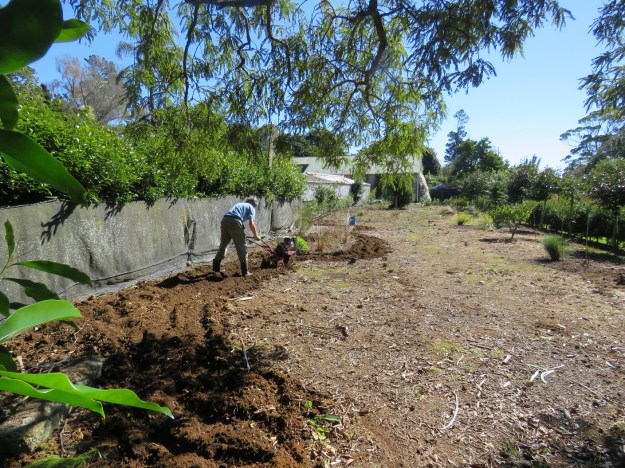
Work starts. A man with a rotary hoe can be a wonderful thing.

My patch is like passage-way to the side of all this, albeit a passage-way in full sun that is about 10 metres wide by 30 metres long; at around 300sqm it is larger than some urban dwellers get in life.  The idea of a “grass garden” has somewhat morphed into “grasses and other plants with long, narrow foliage and spear-shaped foliage”. The plant palette is broadening substantially as I go but still restrained overall, by our standards. “You are not copying the Bury Court garden, are you?” asked friend and colleague, designer Tony Murrell. Well, no.
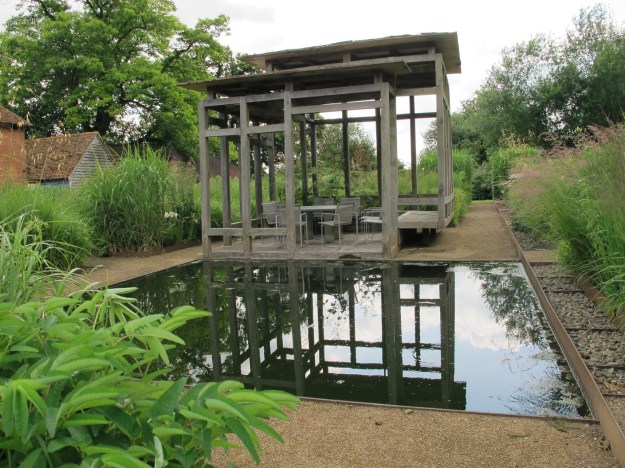
The grass garden at Bury Court

The hallmark of Bury Court was the sharp edged, geometric design filled with billowing grasses – a signature style of English designer Christopher Bradley-Hole. No hard-edged design in mine. We want even the path to meander informally without sharp definition.

From memory, Bury Court’s garden is fully deciduous in that English and Northern European style. We just don’t do fully deciduous gardens in New Zealand. Our climate is milder but also our native flora is almost 100% evergreen so we think in terms of foliage and flowers all year round. My ratio is probably closer to 60% evergreen and 40% deciduous.
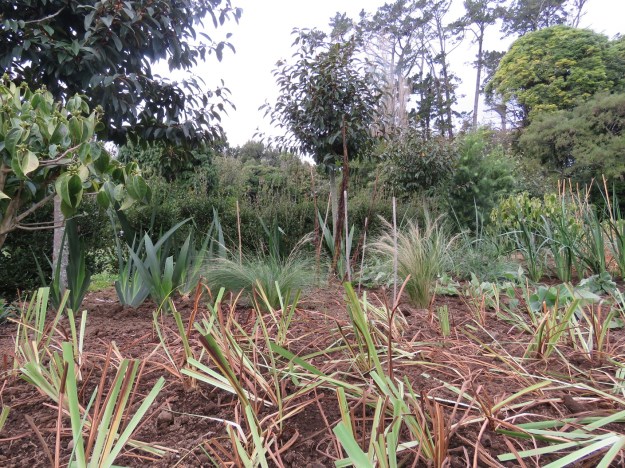
Not exactly Bury Court but planting has started

Bury Court’s garden was, I am guessing, big budget. What we lack in budget, we have, I hope, made up for in sustained thought and discussion over a fairly long period of time, along with the trialling and analysis of most of the plant material. At the back of my mind, I keep repeating some of the points made by Tim Richardson in the book I reviewed recently. “Immersive, not pictorial”, I say to myself. These are not twin herbaceous borders. They are an antipodean interpretation of the New Perennials movement and I chant like a mantra the words ‘rhythm’, ‘drifts’, ‘billowing’, ‘repeats and echoes’. It is a whole new approach to composing with plants for me.

Because we are not buying in the plants but relocating them from other areas in the garden and from small accumulations in the nursery, it is more work digging and dividing than simply knocking out of pots. But I am also starting with larger plants and with the luxury of plenty of plant material. I repeat again, a lot of thought has gone into the plants to be used – a few years of thought and observation.

We have never seen gardening as instant gratification and there is much work to be done in this new area before we are ready to share it in a few – or maybe several – years’ time.

Radio Live has now set up a separate site with Tony Murrell’s Home and Garden Show audio and photos so it is a whole lot easier to find than before. Last Sunday, Tony and I were talking about hybrids and species. Coming up this Sunday, we are discussing cottage gardening. I tell you, I leap down the stairs as my alarm rings 6.23am, make myself a cup of tea and am sitting wide awake and firing on all cylinders for when the phone rings at about 6.32. These are relatively extended discussions we have and it takes quite a bit of combined concentration, especially at that hour of the morning. For me it is a new skill to be focusing my mental energy on a radio discussion rather than on writing – often the ideas are similar but the process and skills in communicating them are very different. It is probably why I have not been writing as much recently.

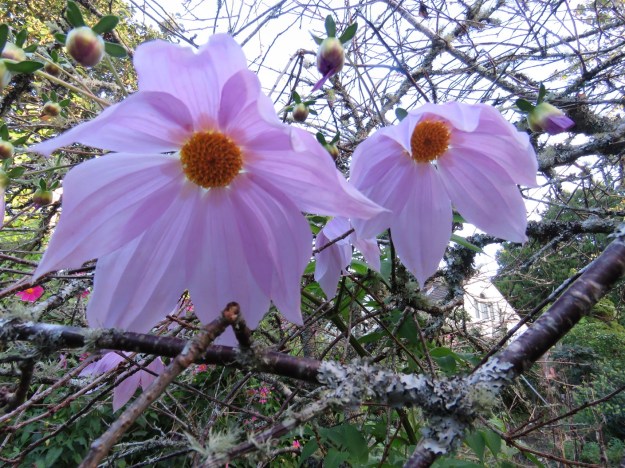
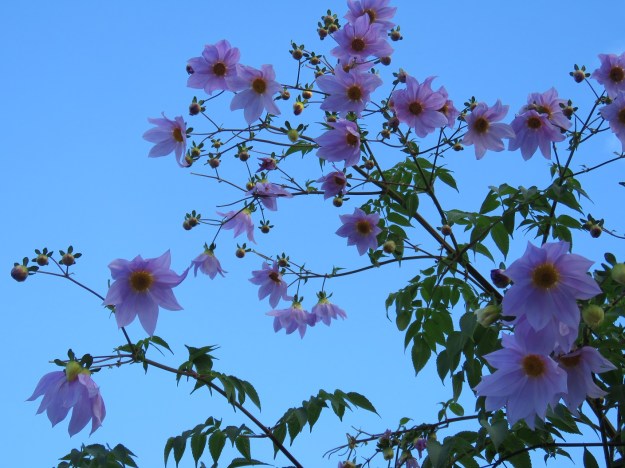
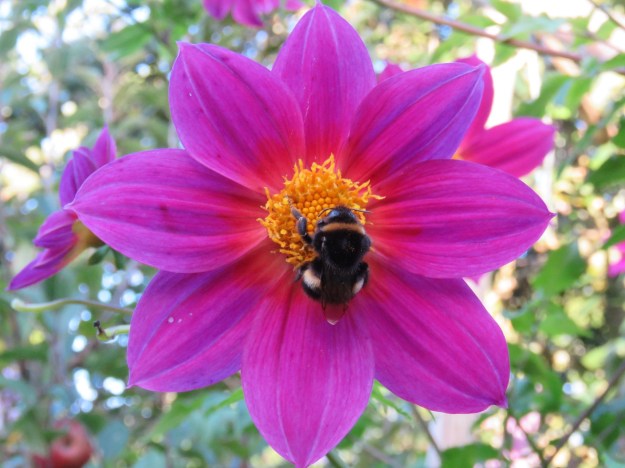
Finally and entirely unrelated, I give you flowers for no reason except to share the pleasure. It is tree dahlia season again.
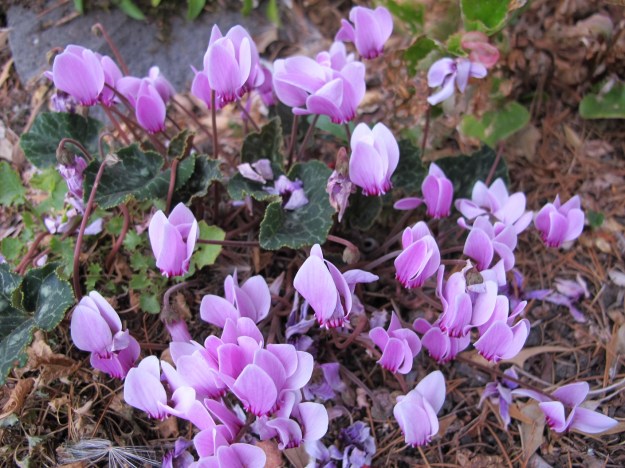
Pink and white detail – species cyclamen.

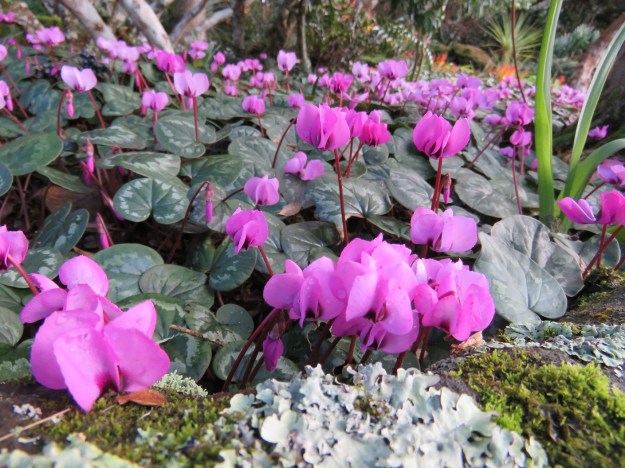
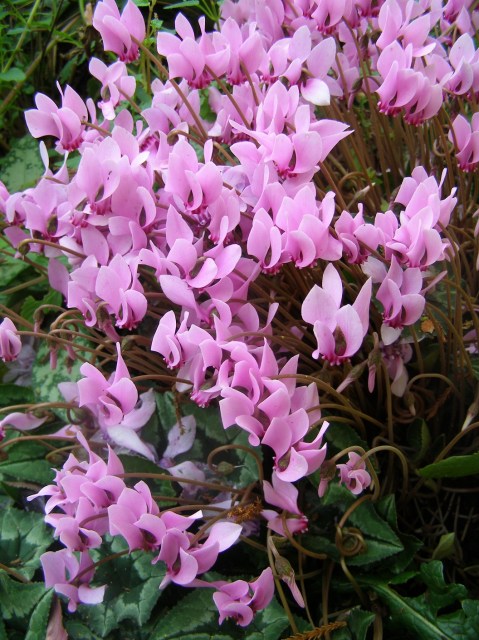
It takes a fair number of cyclamen to create a carpet but it can be done over time

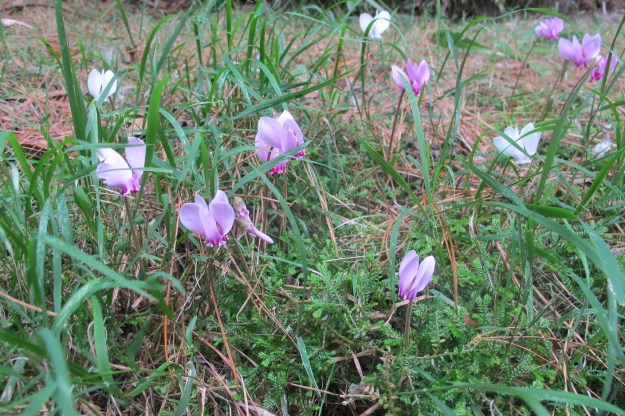
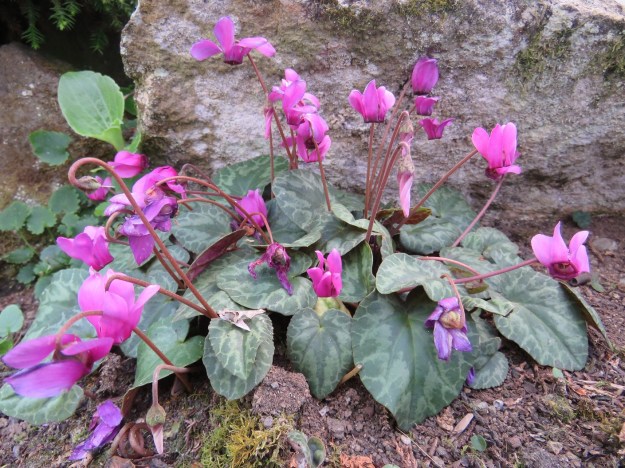
Even though we garden on a large scale across 10 acres, the little pictures are as much a delight as the big ones. For many months of the year, the species cyclamen give us charming detail. Over the years, Mark and his father before him gathered up all the different species they could find. When it comes to showy and proven garden performance, we now rely on four different ones which take us through most of the year – C. hederifolium flowers from January to late autumn, C. coum which takes us through winter, C. repandum for spring and C. purpurascens which flowers on and off all year round. C. graecum also flowers well but does not increase readily.

Cyclamen coum

There is a world of difference between the dainty species and the big hybrids which are sold primarily as house plants. Those are mostly bred from C. persicum, which we also grow but in itself it is not a stand-out performer in our conditions. I am not a fan of the hybrids, even less so when they are used as garden plants. To my eyes, they lack the charm and refinement of the species. They have been bred for a different purpose and have flowers which are much larger, often in different hues and sometimes selected for novelty value in flower form. But that is all a matter of taste.

Cyclamen graecum

A key to understanding cyclamen is knowing where they come from. This explains why C. libanoticum failed to establish as a garden plant here. It is native to the mountains of Lebanon – hardly conditions we can replicate. As it has the most beautiful flowers of any cyclamen I have seen, I was disappointed – though Mark tells me he still has it growing in his nova house (best described as his private but chaotic treasure house of obscure and curious plant material which may or may not transition to the garden, eventually).

Naturalising hederafolium by scattering seed

C. hederifolium (formerly known as neapolitanum) has been the easiest to naturalise for us – to the extent that we can even claim that we have carpets of it. It has a wide distribution from southern France through the Mediterranean to western Turkey, growing in range of conditions from rock and scrub cover to woodlands. We find it is happy in both full or partial sun on the edges of woodland areas but it needs good light levels so is not so satisfactory in shade. Some years ago, Mark scattered seed across grassy banks in our park and now we have it naturalised in meadow conditions. C. hederifolium sets lots of seed which is easy to germinate as long as it is sown fresh and not stored. The seed pods form on the end of corkscrew spiral stems. If you know somebody growing it, you may be able to request some seed.

Cyclamen purpurascens

If only C. purpurascens would set seed as freely, we could use it much more extensively. It is one of the more hardy, European species, occurring naturally as far north as Poland. It is also a terrific performer, evergreen and flowering much of the year. But it sets very little seed and that seed does not germinate readily so it is not an easy plant to increase and naturalise, despite its unfussy ways once it is growing.

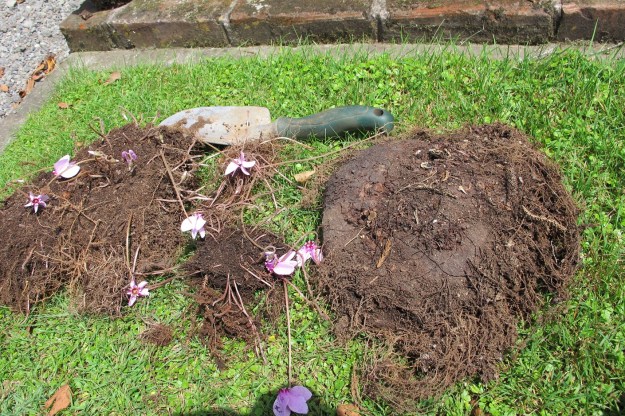
Cyclamen hederifolium tubers with trowel to give scale

Cyclamen grow from flat, disc-like tubers. While hederifolium tubers can get very large – I have measured up to 15cm across on old specimens – our more delicate coum and repandum stay small. I can’t recall ever seeing a repandum tuber much larger than my little finger nail and they are mostly smaller than that. While they still set good-sized blooms, it does mean that you need a fair number of them to have much impact. Siting is also critical. They are not a suitable option where ground is being cultivated. No matter how careful you are, the tiny corms look too much like soil when they are dormant and are therefore easy to discard or dig in too deep. Nor do they like companions which can overshadow and overpower them. Our main patches are on woodland margins, particularly as ground cover beneath tall, limbed-up evergreen azaleas. We leave them undisturbed and they reward us with low carpets of bloom, sometimes combined with snowdrops (galanthus) or the little, dwarf narcissi.  Excellent drainage is also vital. All tubers will rot out in wet or heavy soils.

Hederifolium again

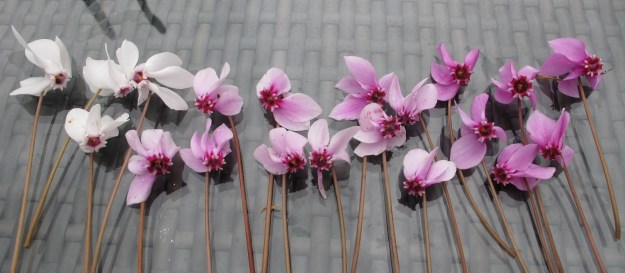
Generally, cyclamen show the typically heart-shaped leaves, usually marbled white or silver and a distinctive flower with upswept petals. They come in white and all shades of pink from palest through to deep cerise. Almost all of them are fully deciduous and like to sit on or in line with the ground surface, rather than being buried.


Shades of Cyclamen hederifolium

As to whether  the family name is pronounced “sike-lamen” or “sick-lamen”, we go with the former though Wikipedia tells me that is the American pronunciation whereas the latter is the British version. Take your pick.

First published in the May issue of New Zealand Gardener and reprinted here with their permission. 

“A garden is really the gardener”

The woman on the left looked a little underwhelmed by Sissinghurst too

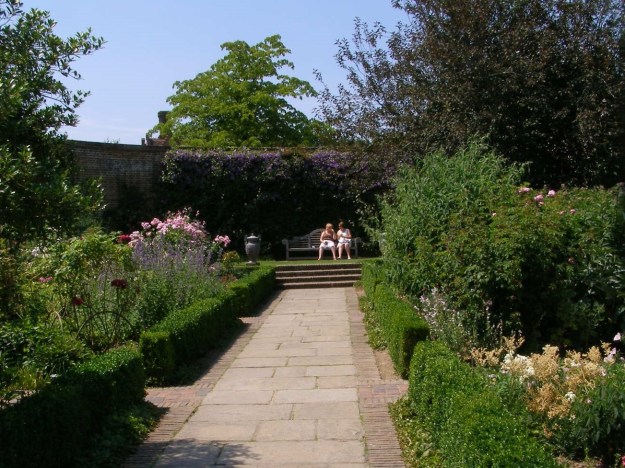
I have always felt I needed to whisper rather than shout that, while we enjoyed our one and only visit to Sissinghurst, it did not inspire us to return. Considering the huge influence this English garden has had throughout both the UK and, more surprisingly, little ol’ New Zealand, I have wondered if we were being overly critical, maybe “gardened-out” when we visited it.

The thyme lawn was not a crowning glory when we visited Sissinghurst

It seems not. I was just going to share the link to English landscape designer Dan Pearson’s latest blog  on our garden Facebook page  but then I thought there is a bigger context for this interesting post of his. Pearson is writing about his advisory work with the head gardener at Sissinghurst to re-personalise that famous garden, restoring some of the energy and also the intimacy of what started out as a very personal garden. Over time, Pearson observes, “The way the garden became was ultimately driven by the need to provide for increasing numbers of visitors and, in so doing, the intimate sense of place was slowly and gradually altered.”

And there is the conundrum when a private garden enters the public domain following the deaths of its creators. If it is successful and well-resourced, the expectations of the visiting public play an ever-larger role in determining how the garden will be presented and maintained.

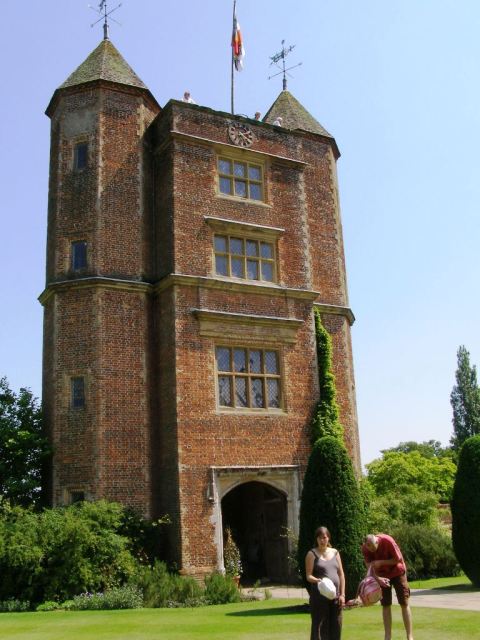
… but the Sissinghurst tower did not disappoint. However, it is structural and therefore a permanent feature

I had been reading some debate about this in the book by Tim Richardson, “You Should Have Been Here Last Week”. As far back as 2004, he was sounding the alarm bells about Sissinghurst. Writing for the Garden Design Journal, he said: “Every day, coachloads of people turn up at Sissinghurst to experience Vita Sackville-West’s garden, yet what they get bears no relation to the original in terms of content or atmosphere”. Further on in the book is his 2015 update, welcoming the appointment of Troy Scott Smith as new head gardener with Dan Pearson in an advisory role.

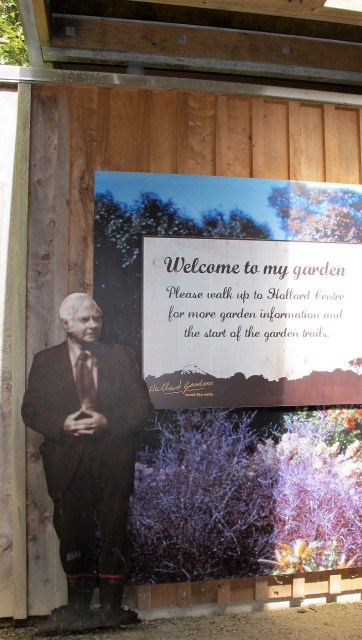
We have watched with interest the developments of the “regional gardens” in Taranaki – the ratepayer funded gardens of Tupare and Hollards (both created as very personal visions with owners long dead now) and Pukeiti. When the takeover was first being promoted by the regional council, I wrote several strong pieces for the local paper (see below), frankly alarmed at what was being proposed, let alone the budget. In the years since, we have backed off expressing our views publicly about what is happening in these gardens. All I can say is that in my last visit to Hollards, I felt that the originators, Bernard and Rose Hollard, had pretty much disappeared, bar some faded photographic display cut-outs of Bernie.

The faded life-size cut-out of Bernard Hollard is a little poignant

I don’t think these gardens are a victim so much of their own success – we simply don’t get enough garden visitors to Taranaki to put extreme pressure on gardens. I think they are a victim of the drive to attract numbers of general visitors to justify the expenditure. If that means sacrificing the original ambience and character of these gardens, then so be it.

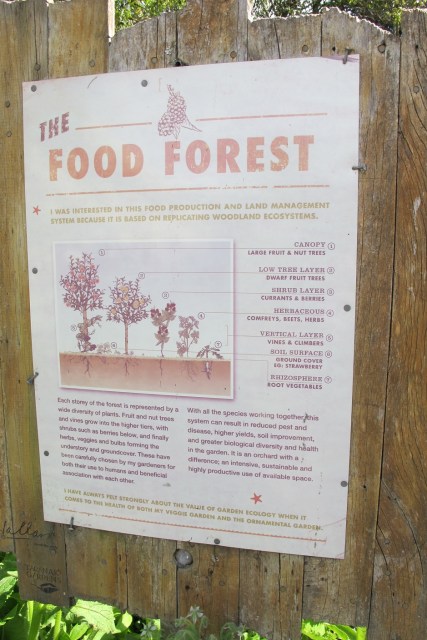
Matched by faded information boards, purportedly written in the first person. Was the term “food forest” even heard of when Bernard Hollard was still alive?

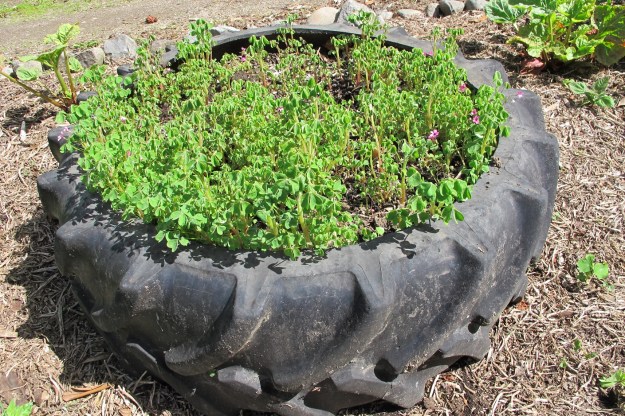
Mark knew Bernie, as he was known to his family and friends, personally and is adamant that he would never have grown yams in an old tractor tyre and indeed his tidy vegetable garden was hidden away from public view

Pearson captures it in a nutshell, when he writes: “Even when the blueprint is strong, gardens can easily assume a different character, for a garden is really the gardener.”

Hollards’ modest home was demolished to make way for a visitor centre, designed in the style I call “Utility Department of Conservation”

Earlier published columns on the topic of regional gardens:

1) A letter from a ratepayer. Published July 2010 I am not sure I would be brave enough to publish this piece in the newspaper these days. I must have been more fearless back then.
2) A tale of Pukeiti Rhododendron Trust and ratepayer funding Published March 2010.
3) Taranaki Regional Gardens Part 1 – first published late 2004
4) Taranaki Regional Gardens Part 2 – first published, apparently January 2005 – the best piece of writing for those who can’t be bothered wading through the lot.
5) And Taranaki Regional Gardens Part 3 – which rather tells about the treatment of an unsolicited submission. (first published 2005). When in doubt, levy accusations of self interest.

Treading more lightly on the land

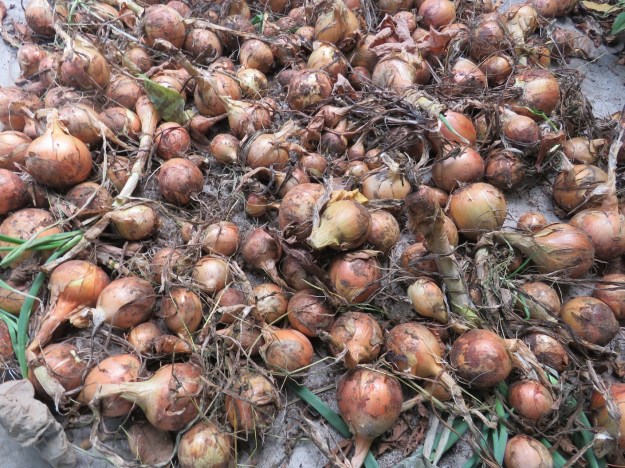
The onions are not the main purpose of this story – more on those a little later. They are just more visually appealing than the sight of rubbish sorting at its most basic level.

I mentioned in last week’s post the heartening sight of how little landfill waste was generated by the 50 members of the IDS when they lunched here.   This week it was a coachload of Massey University environmental ecology students who visited. I put out my labelled pots for the waste, curious to see how they would respond. They passed with flying colours. Of course they did. What else would one expect from these young people on whom rests so much hope for the future?

I now realise what I have failed to do is to photograph the lunch food laid out for these large groups. Therein lies the key to minimising inorganic waste. With the IDS, the menu included quiches cut in squares, small filled rolls, green salad and fresh watermelon for dessert. And coffee, tea and chilled water served from large jugs. All the food came out on china or wooden serving dishes. The only disposable items used were the cardboard ‘plates’ and bamboo forks.
The students had an expansive range of options from which to assemble their own filled rolls and sandwiches with fresh fruit to follow. Plus the option of yoghurt and treats like muesli bars which admittedly generated individual waste. But the bulk of the food was in multi-use plastic containers and even the butter came cut in individual cubes from a large block so there was no packaging needed and no wastage. The students had been told to bring their own water bottles which they refilled from a nearby tap.

I have learned two things. If you set up a situation where individuals are expected to sort their waste, they do it but most waste is reduced by the steps taken in the catering. We have become so used to individually packaged portions – marketed as being both convenient and hygienic – that many people have forgotten that it used to be done differently and sometimes that is better. A sandwich or filled roll prepared on the spot to one’s own tastes is hugely preferable to getting one somebody else prepared four hours earlier and then left to sweat in its own plastic cling-film wrapping.

Soy beans! Part of the Tikorangi soy bean crop

Waste is much on our mind here. Hence the onions seen above. And the delight at a successful soy bean harvest. Why onions and soy beans when they are extremely cheap to buy, you may wonder. Why not grow the higher value crops? We grow those too, or at least Mark does. Space is not a problem for us. But commercial onions are reputed to be one of the most heavily sprayed crops and we know ours are spray-free. And soy beans may be cheap as chips but they also come with very high food miles. The food miles are on our soy beans are zero. Besides, when it comes to taste treats, freshly picked edamame beans steamed and sprinkled with a little rock salt is right up there as gourmet food.

Not all crops are worth growing. The peanuts gave a really good yield last year but were so tedious to de-husk by hand that even Mark decided they weren’t worth the effort. He is quite happy to prepare the beans, seeing his attempts to produce as much food as he can from our own property as a worthy challenge. Not only does it hugely reduce the amount of waste we personally produce but we also know the origin of our food, the conditions in which it has been grown and the age of the produce.

This all feels like a return to where we were at back in the 1970s, though we are more lined and more experienced now. If more of us had stuck with that rejection of consumerism back then, maybe the world would not be in such a parlous state.

One man has indeed made a good start on the annual a-mowing of the meadow

Applying related principles of lightening our footprints on the land to the ornamental garden is an entirely different topic because there is the added factor of aesthetics. We are spending a lot of time discussing and experimenting here but in the meantime, I can tell you that one man went to mow, went to mow the meadow. With our smart new sickle-bar mower because that is all that could handle the mountains of meadow grass. So much grass, in fact, that Mark was wondering if we should be teaching ourselves the old skills of building haystacks. This current and most major mowing is just the latest instalment of an ongoing experiment.  How far can we change our gardening habits and tread more lightly on the land yet still be happy with the high aesthetic values we strive for in the garden? Time will tell.

“Fell the trees” is the cry.

The Devon Street alders are to get the chop

Trees in the urban landscape have a hard life. More often maligned than admired, battling on in remarkably inhospitable situations, it is rare that they reach maturity. In New Zealand at least. It is even more rare in New Plymouth with its coastal and mountain views. A leafy tree is likely to survive better in a flat, inland city like Palmerston North where it will never get in the way of some ratepayer’s view.

The trees down the main street of New Plymouth are to get the chop. They drop too many leaves and make the footpaths slippery and many people hate them. We happened to be dining at the weekend with a group that included dendrologists – in other words, people with a much better than average knowledge of woody trees and shrubs. Conversation turned to the Devon Street trees.

These are just alders. A boring, utility tree at best, but capable of thriving where less resilient trees will suffer. Opinion across the dinner plates was divided. A few thought it was a tragedy to cut down perfectly healthy trees fulfilling a role of greening the city. Others thought they could be replaced by something a great deal more interesting. It is hard to argue with the friend who emailed me the next day saying, “The alders always remind me of dank and dark South Wales where they are planted on the bulldozed slag heaps, as alders cope with the poisonous soil.” He was hoping for palms which are more evocative of the tropics.

But replace them with what? Metasequoia, maybe?

I think it would be fair to say that the majority opinion was that the alders can go but they need replacing with a better option. Therein lies the problem, for I fear the ignorant majority would probably be quite happy to see nothing come in as a replacement because all trees are ‘messy’ and a concrete jungle doesn’t worry them at all. Hope lies with the staff at the district council who may be more enlightened about greening the urban landscape. But it won’t be easy.

First up, removing the alders will likely require lifting the pavers that surround them and replacing a fair amount of the soil. It is not just a matter of chainsawing off the tops (though that will be no small task) and getting the stump grinder in to take out the bulk of the root ball just below the surface. Leave all those feeder roots in place – and they will spread far and wide – and the risk of soil borne fungus (particularly armillaria) attacking the new plants is high.

Amelanchier, maybe?

But the huge issue is what to replace them with. There is very limited space. Whatever comes in must have small leaves and small flowers that decompose quickly. Much and all as we would love to see magnolias used, evergreen magnolia leaves take years to rot down and deciduous magnolias have enormous leaves and flower petals, all of which will fall every season. Anything that forms a canopy is going to need extensive pruning and training and for the council, that costs money.

Deciduous or evergreen? Contrary to ill-informed opinion, evergreen trees drop leaves too. It is just they do it all year round instead of one hit in autumn. What can survive and thrive in a heavily polluted environment with an extremely restricted root system? Dinner time suggestions ranged from metasequoia (the restricted root system would stunt the top growth to a more manageable size), amelanchier (autumn colour, spring flowers, small leaves and petals but still plenty of them and it does not have a great natural form), Melia azedarach (though it may prefer a drier climate), pseudopanax (tough leaves, not a highly prized native, generally) and palms. The last option was somewhat favoured but Mark and I are cautious. Palms would look exotic. It would be possible to choose some options that would take the conditions. They are tall and narrow so take up next to no space. But – and it is a big but – as they mature, those fronds are often very heavy and a frond falling from a height in our frequent winds would do significant panel damage to vehicles parked below as well as potentially ripping off the spouting from verandas as it falls. Imagine the outcry….

Handsome, but…

… these falling fronds can cause significant damage

Mark takes the somewhat depressed view that maybe some shrubs in a planter box are the best we can hope for on the main street of New Plymouth. Unimaginative, utility and suburban.

Gleditsias. NOT our native kowhai

On the funny side, the little town of Waitara is local to us and it has gleditsias planted along its wide main street in a yellow and blue colour scheme. Even these trees are controversial. I have been at local meetings where landowners and business folk want them cut down because they drop leaves and are ‘messy’. But Mark likes to tell the story of when they were planted. A local councillor said to a noted local environmentalist: “You must be very pleased to see kowhais being planted on the main street.” I mean gleditsia, kowhai – not a lot of difference, eh? But maybe a good lesson on not leaving the blitheringly ignorant to make decisions on trees in public places.

For those loyal New Zealanders who think we should only be planting native trees, the trouble is that most of our native plants have evolved to grow in forest conditions. The roll call of suitable options for the stand-alone, exposed, windy, confined conditions of a narrow streetscape is very small indeed.

Melia azedarach – a pretty small tree but hardly one of stature and longevity

We can never overuse this meme