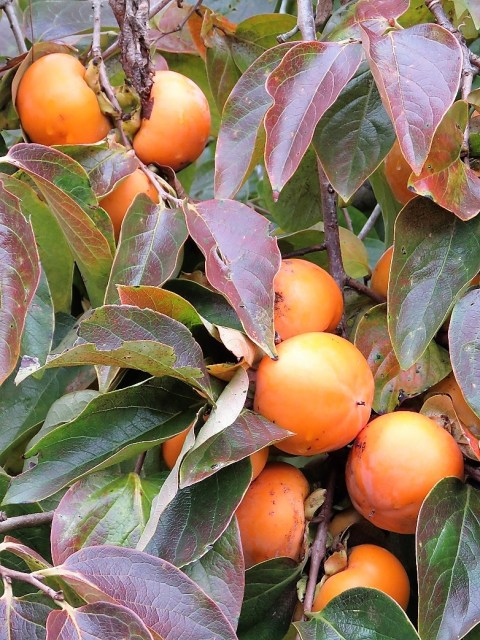
Persimmons framed against the autumn blue sky
Our autumn days are not always like this. We have had a week of dreary, grey and cold weather interspersed with rain every day. It can be very dispiriting. But it is more common for us to have days like today’s glorious morning when the persimmons make a colourful sight. The intensity of light and colour we get all year round here is something we take for granted, in the main. It is not until I travel overseas that I realise this is not common in many other climates.
The persimmons are the old fashioned, astringent variety which need to be very soft and ripe to eat. I have a couple of trays ripening. This year I want to try mashing the flesh and semi-drying it as fruit leather to use in baking. Persimmons make a reasonable substitute for dried apricots. The birds are enjoying the majority of the crop which is still on the tree.
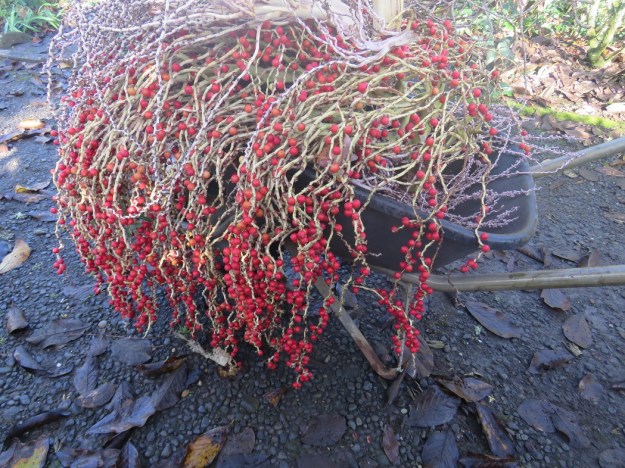
A barrow full of bangalow seed
I have written before about the invasive habits of the bangalow palm, Archontophoenix cunninghamiana, and why we think it should be on the banned list for commercial sale. Because ours are handsome plants, Mark has been loathe to get the chainsaw out to drop them but he does get the extension ladder out to cut off the seed. Behold a barrow full of seed, though Mark observes that many more fell off and are lying at the bottom of the trunk. The problem with the seed is that the birds spread it and it can out-compete our native nikau palm (Rhopalostylis sapida). I do wonder at what point Mark may reach for the chainsaw rather than the extension ladder, because allowing such prolific seed-set on plants we know are invasive is unacceptable in our personal gardening philosophy.

Bulding an extension to the banana frame, using giant bamboo

Protecting one of several bunches. We are currently eating our own, homegrown bananas
The extension ladder was also required for the covering of the bananas for winter. “I had to build an extension to the frame,” Mark said and that was no small task. The bananas are the one and only plant we cover for winter and with the best ever crop of ripening bananas, this was even more important this year. Being 5km from the coast as the crow flies, we are not quite frost free here. Most tender plants can cope with the occasional minor frost as long as we place them carefully, but the bananas are marginal at best and warrant the special attention if we want the crop.
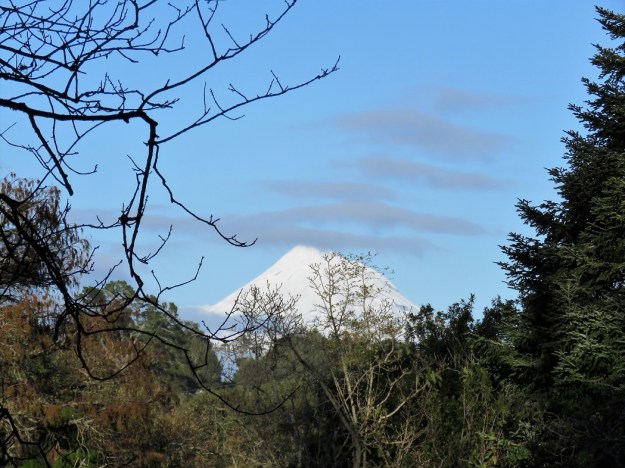 As our maunga – or Mount Taranaki to non-NZ residents – has put her full winter raiment on this week, it was a close-run race between the covering of the bananas and the first cold snap of winter. Not that we have had a frost yet.
 The ladybirds have moved inside to hibernate. They creep into the crevices of the upstairs wooden joinery which can make opening and shutting the windows challenging. I was fine with this annual event until a social media friend suggested that they looked to be the pest Harlequin ladybird which is a far grubbier and less desirable version of the charming, common ladybird. I suspect she is right, though the first reported incidence of the Harlequin ladybirds was up north in 2016 and we have had these hibernating critters for longer than that. So either they have been in the country longer than has been reported, or we have some other form of this beetle. I see there are 6000 different types of ladybirds so unravelling the different ones is beyond me. They are a bit messy, so I may flick them back out the windows with the duster.
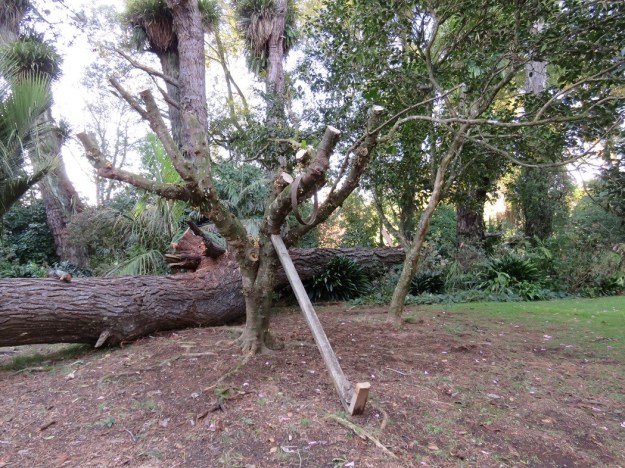
Propping up the Ficus antiarus
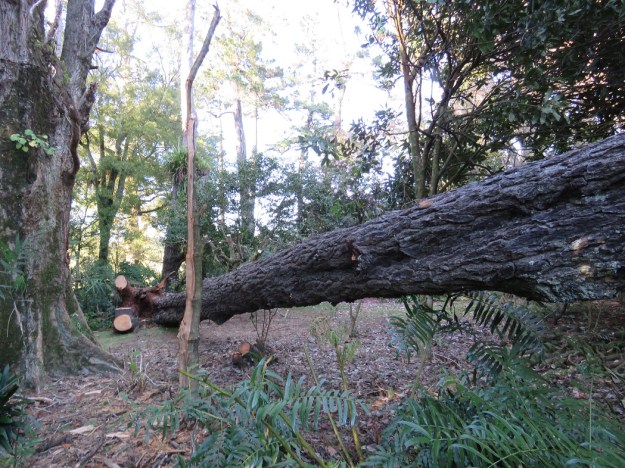
I see it was April 11 when we had the last major treemageddon incident. Our Lloyd – our incredibly obliging and handy man here – did a fantastic job to get the clean-up to this stage. The poor Ficus antiarus is but a shadow of its former self after being completely uprooted. It remains to be seen how tough it is in longer term survival. The 140 years of straight Pinus radiata trunk may be destined for firewood after all. We have been unable to find anybody with a chainsaw mill who could mill it on site for us. The poor stripped remnant of a plant to the left of the trunk in the second photo is, or maybe was, a fruiting macadamia tree.
Mark is now looking in askance at the splendid specimen of Abies procera ‘Glauca’, a magnificent tree that he is worrying may be a ticking time bomb here. We are usually philosophical about large trees that fall but that is because their location means they will fall without damaging power lines, drainage pipes or buildings. The abies, alas, is more likely to fall on our house and cause major damage. He is wondering if it is time for us to make the hard call and fell it in a safe direction. Every time he mentions this, he expresses regret that his father planted it so close to the house. But that is so often the story with big trees – most people never factor in their potential size as they reach maturity.
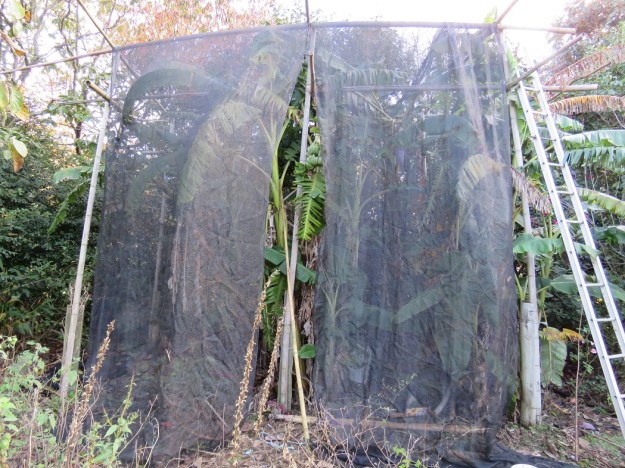
The Theatre of the Banana, as I describe the protection of the only plant we wrap for winter
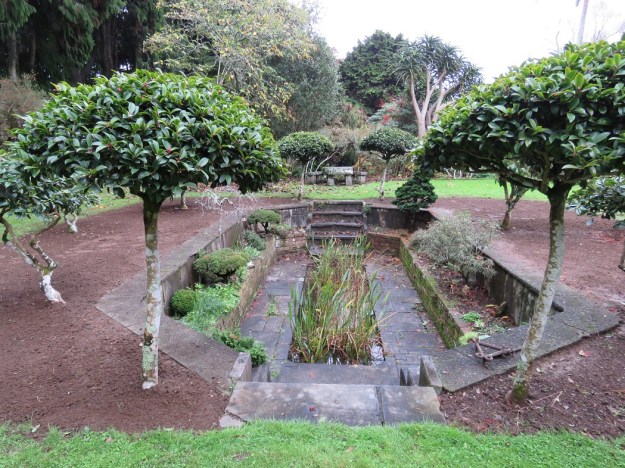
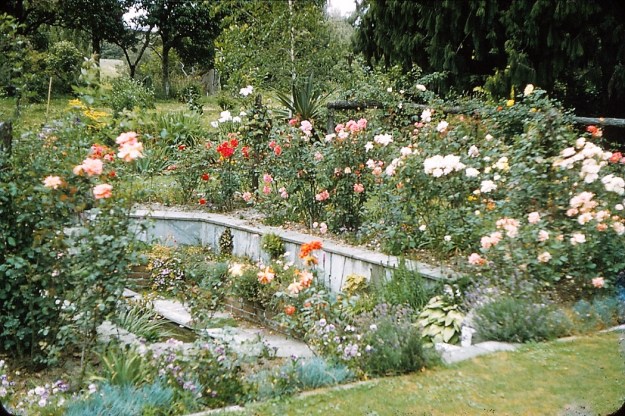
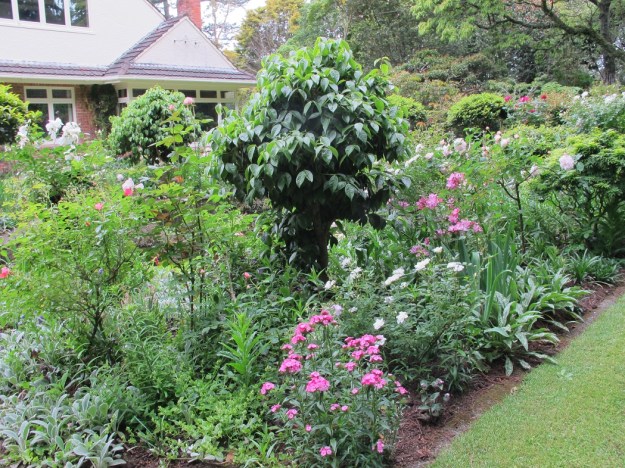
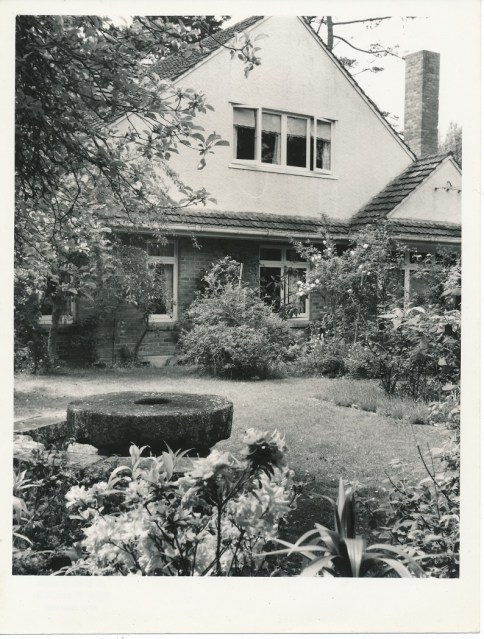
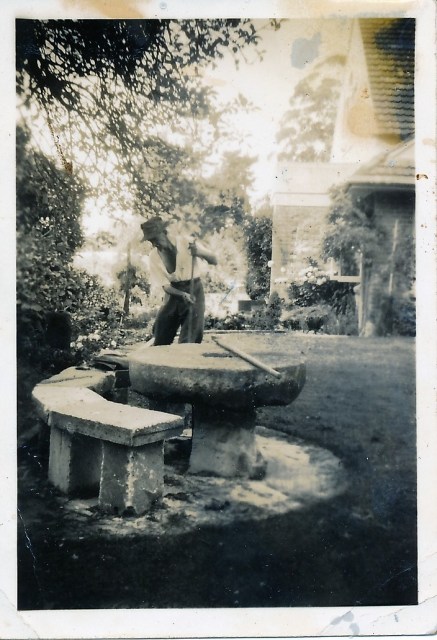
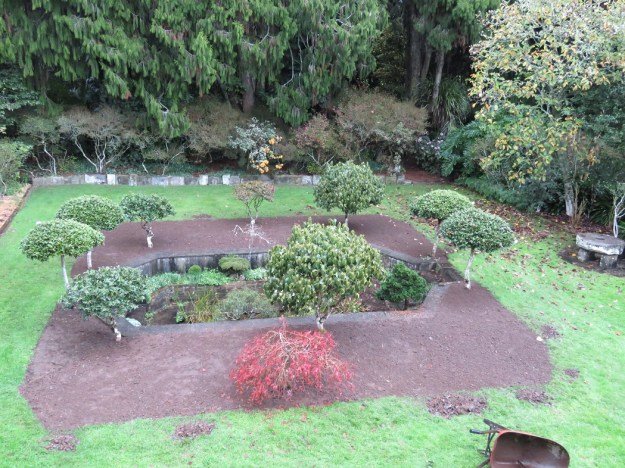 Finally, the last plants were gone at the weekend and the area was bare. Lloyd, our extraordinarily handy and obliging man about the garden, has moved in extra topsoil and raked and levelled to get it ready for sowing in grass. The eight camellias and two maples will stay and be shaped into gnarly, character, feature plants. We normally avoid growing plants in mown lawn areas and I know I will have to hand-trim the grass around the trunks but I am willing to do that. We do not like the weed-sprayed brown look of lank grass around trunks and I have no desire for the tidy, suburban look of encasing each trunk in a tidy round concrete circle planted with pansies. For those of you who want to know what the camellias are, two are the gorgeous species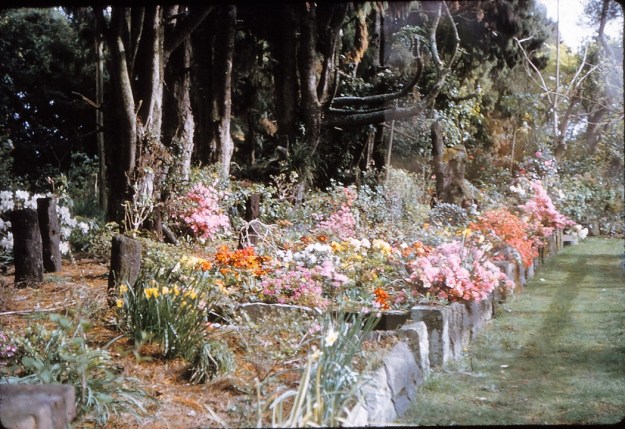
 Beth Chatto dead? This should not be a surprise.
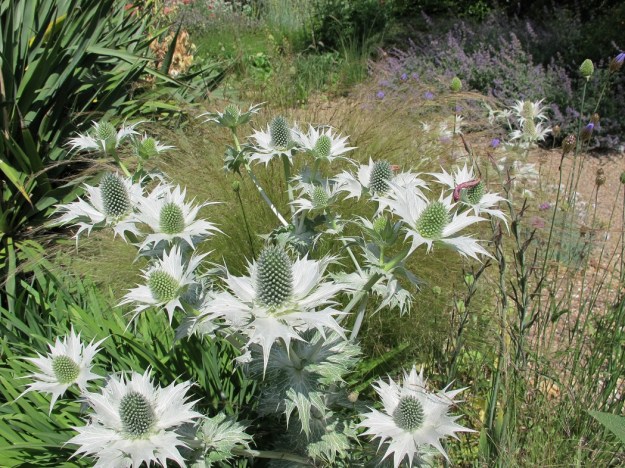
 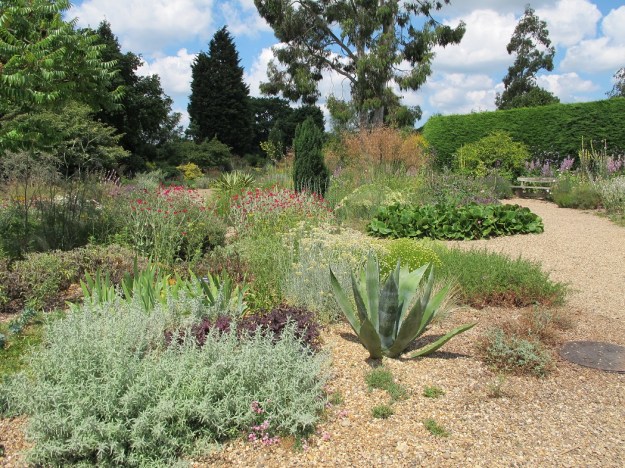 We returned to her garden with Charles in 2014 but she was too frail that day to join us. It was a bright, sunny day and I have since regretted that I did not get good enough photos of her dry garden in the glaring light.
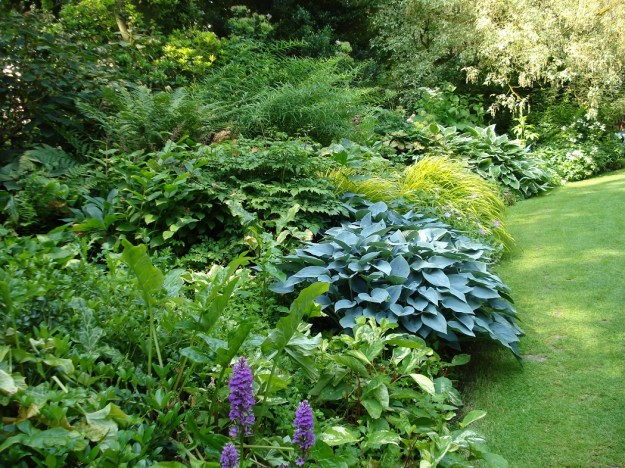 The original garden is perhaps a little dated by modern standards – rather a lot of curvy, hose-pipe borders – but always managed to the highest horticultural standards and underpinned by that knowledge of which plants will perform in those conditions and co-exist well with each other. I would love to see the woodland area in early spring when it must be magical but the UK in early spring is a bit cold for us these days. It is the dry garden that lifts a visit to another level altogether.
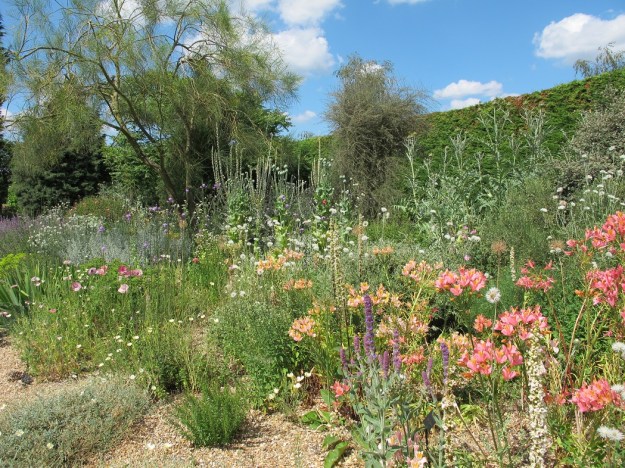 We have spent quite a bit of time making sense in our own minds of contemporary European and UK gardening trends – New Perennials (where Piet Oudolf’s work is still the gold standard), the New Naturalism, meadows, prairies, ecological gardening, matrix planting, sustainable plant communities and what we call the romantic revival or, simply, romantic gardens. And in Beth Chatto’s garden, thirty years ago, she was creating the precursor to all these modern trends in her new dry garden. In a very dry climate, nothing is irrigated in this garden built on a compacted carpark and river gravel. The skills lie in plant selection and the light-handed but deft management which allows plants to have their own space and follow their own natural inclinations. She had a rare combination of exceptional plantsmanship and top-level gardening skills.
 I did not so much appreciate her


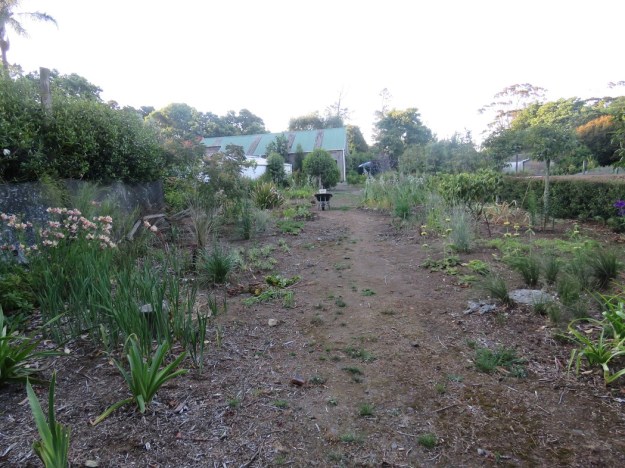
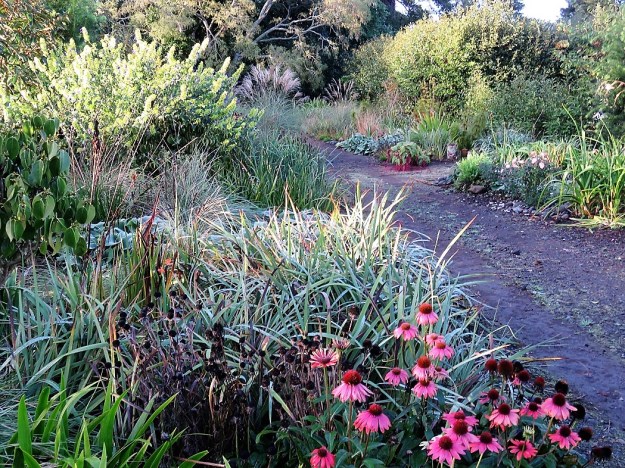
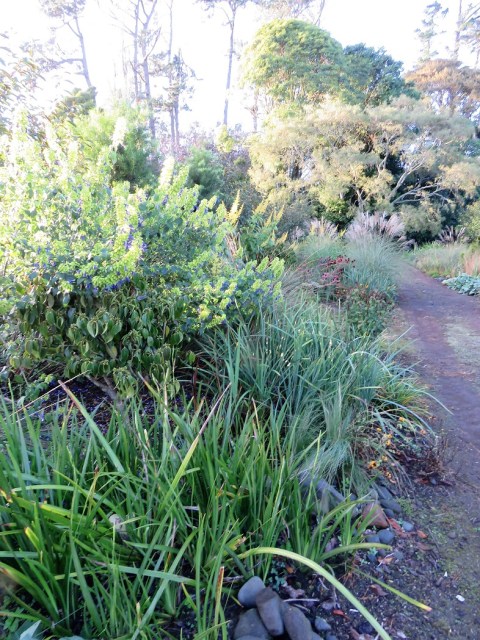
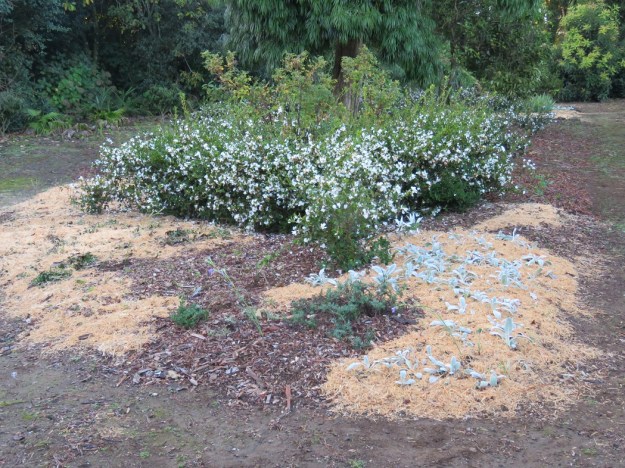
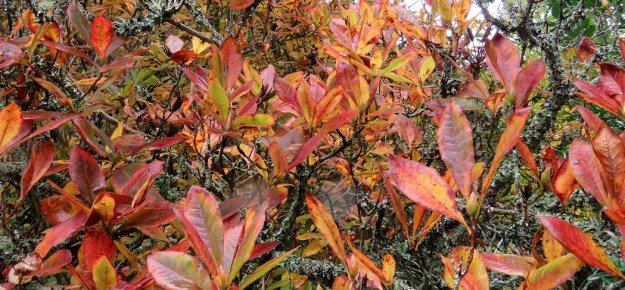 I do not know whether it was the rainy Saturday that made me pensive or whether it was my somewhat melancholy state of mind. Either way, I took a damp walk around the area we call the park. While the autumn colours seem quite striking this year and relatively early considering we have only had two cold days so far, I am not sure that damp autumn days are uplifting to my soul.
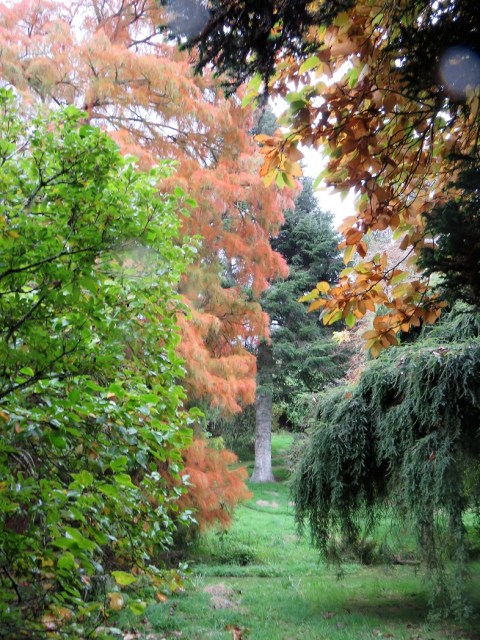 But I have been pondering the differences between those of us who see gardening as a process and those who see it as a product. I am happier in the company of the former – those who enjoy the act of gardening and see it as a journey where there may be a destination in mind but experience says that such a goal will be but transient and fleeting and not an end point at all. For a garden can never be static and frozen in time so will never be finished or full. I suspect these are the characteristics of a gardener.
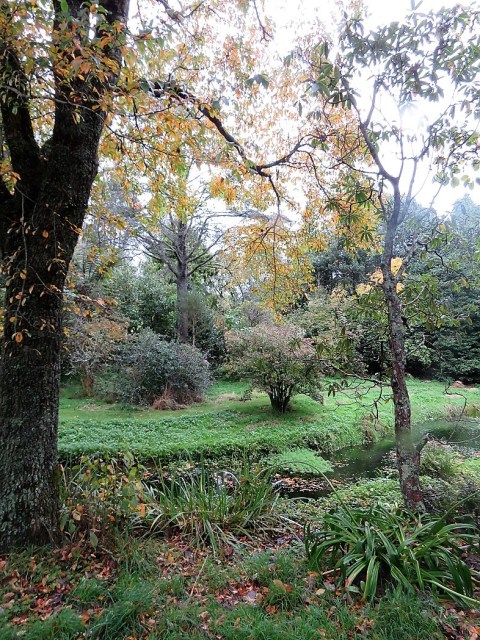 There are many who see a garden as a product – a particular destination or point of achievement in a creation that can then be frozen in time. This, I think, is probably a viewpoint of a garden owner who is not a gardener by nature. I felt a passing pang of sympathy for landscape designers. I would guess the majority of their paying clients fall into this category. Some may come to understand the whims of nature but many more make a rod for their backs, requiring that a garden be preserved in pristine condition at a certain point of its development.
 But Sunday dawned fine and dry which meant my usual cheerful disposition was restored. We cannot complain about an autumn which delivers us a daytime temperature of 24 degrees Celsius and night time temperature still well into double figures. Behold Mark’s pride and joy – his luverly bunches o’ bananas. Several lovely bunches. We are super marginal when it comes to growing bananas for tropical we are not. These are the only plants we cover for winter – festooned in protective shade cloth suspended on a giant bamboo frame.