Flowering this week – Magnolia Iolanthe

Iolanthe - unsurpassed this week

Iolanthe – unsurpassed this week

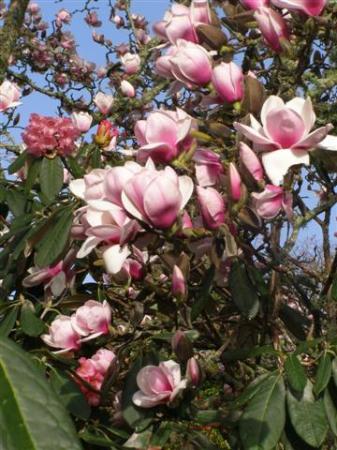
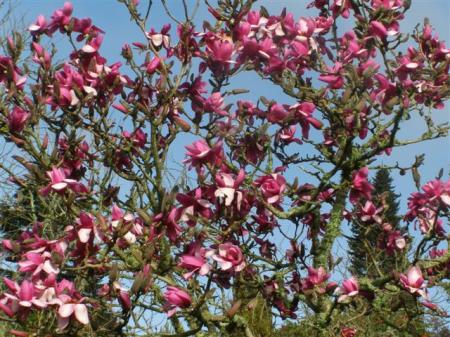
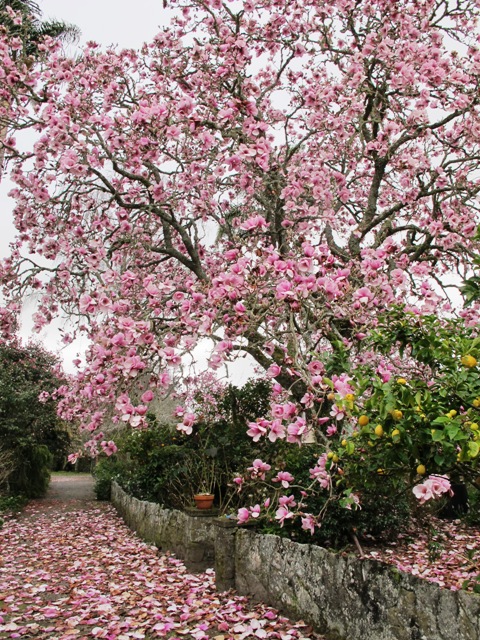
Yes, I admit it we are rather dominated by magnolias at the moment but at this time of the year we live and breathe them and the current all-round-simply-astounding plant has to be the original Magnolia Iolanthe. It is a tree of grand proportions after nearly fifty years and in full flower, it really can take your breath away. We describe it as the original Iolanthe because it really-o truly-o is the first plant, grown from a seed of a controlled cross by Felix Jury. A controlled cross is a deliberately managed hybrid, as opposed to a chance seedling. He heeled a number of the resulting seedlings into his vegetable garden, intending to plant them out to beautify Waitara but Iolanthe popped open a flower. And even that first flower indicated it was pretty special. So special in fact that the plant remained where it was heeled in and these days Mark is moving the vegetable garden rather than attacking the tree. All other Iolanthes around New Zealand and the world have been propagated in the first instance from the tree that graces our driveway.

We still rate Iolanthe as a top variety in the soft lilac-pink and cream colour range. It has a very large flower and because it sets flower buds down the stem, the flowering season is long. If one set of blooms is damaged (the hail storm on Tuesday last week wasn’t great and nor was the follow up last Sunday), within a week a fresh set of buds opens. And there is a second flowering in summer. We did once see Iolanthe plants being sold in a garden centre with labels describing it as a small tree to two metres. I don’t think so, but if you have sufficient space, Iolanthe is unlikely to disappoint..

The inspiration for the name came from the late Iolanthe Small, the dedicated plantswoman who spent the better part of her lifetime working in the Fernery at Pukekura Park.

September 4, 2009 In the Garden

Spring is officially here though for most of us, the advent of spring came last month. While cooler inland areas will continue to get a few frosts, in coastal areas we would be unlucky to get frosted now.

  • A reminder to hard prune rhododendrons (including vireyas) now if you are planning to do so. Don’t delay. Prune, feed, mulch then cross your fingers and hope.
  • If you have had enough of winter pruning, you can lift and divide dahlias now. In colder parts of the world, these get lifted every year and wintered under cover but here we tend to plant them once and leave them. Overcrowding can cause the plants to fall apart in full growth so thinning out the tubers every few years is helpful.
  • If you haven’t lifted and divided evergreen grasses, at least give them a brush up to take out the unsightly build up of dead foliage in the middle. You can use a sturdy leaf rake, small fork or your hands – but if you are using your hands, wear gloves to avoid leaf cuts (the equivalent of paper cuts.)
  • There is an open verdict here as to whether the failure of daffodils to flower is due to growing them in ground which is too fertile (so they put on lots of leaf and no flower – also a sign of too much nitrogen in the ground) or whether it is the effect of the narcissus bulb fly laying its eggs in the crowns of the bulbs last year. If you find hollowed out and rotting bulbs at any stage, or if you dig them when dormant and find large white maggots in the centre, then you have narcissi fly in your garden. They are difficult to beat, though I have seen Mark, like his father before him, stalking them in the rockery.
  • Potatoes, peas and carrots can all be sown directly into the vegetable garden. It is the very last chance for onions, be they red, brown or shallots, if you want a good crop. Last chance also for garlic. Green crops must be dug in now to give them time to start breaking down before the Great Labour Weekend plantout. Experienced veg gardeners are starting with seeds of summer crops such as tomatoes, cucumbers, melons, pumpkins and the like to get a jump start but you do have to sow these in trays and pots and keep them under cover for a while. Inexperienced gardeners will probably buy the baby plants they need from the garden centre late next month.
  • Early aphids are appearing already. Get onto them early with pyrethrum or an organic soap spray to avoid an exponential population growth. Flyspray does at a pinch. It is pyrethrum based though made synthetically these days rather than from the daisy. Dead head hellebores to stop the aphids setting up home in the spent flowers.

Magnolia Diary 9, 1 September 2009

Click to see all Magnolia diary entries

Click on the Magnolia diary logo above to see all diary entries

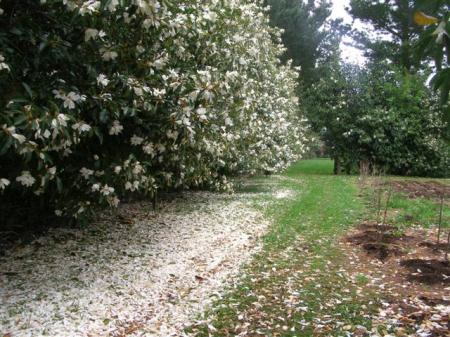
Iolanthe yesterday morning after the storm - the petal drop was prodigious

Iolanthe yesterday morning after the storm - the petal drop was prodigious

Another fierce storm here two nights ago sorted out the durable magnolias from the fly by nighters. Poor old Mark Jury has gone for the year. He only looked sensational for a week. But his progeny are faring better. It is pretty remarkable how much petal drop we can get from Iolanthe and still have a tree full of flowers. The winds blew the petals over 40 metres away. These are short, sharp incidents of storms which last a few hours only but the strong winds and torrential rain certainly causes damage to magnolia blooms. Viewed from a distance, Felix Jury looks great but seen close up, there is quite a bit of damage and bruising and it is the same story on Iolanthe, Milky Way, Lotus and Athene. Cultivars which flower down the stems (as opposed to the short lived stars which set flower buds only on the tips so there is one mass flowering and then it is over) extend the season and there is a second chance to open undamaged blooms. Our white stellata is bravely flowering on through all conditions. Suishoren can blow apart rather easily whereas Manchu Fan takes pretty well all the bad weather in its stride.

Burgundy Star opening its flowers

Burgundy Star opening its flowers

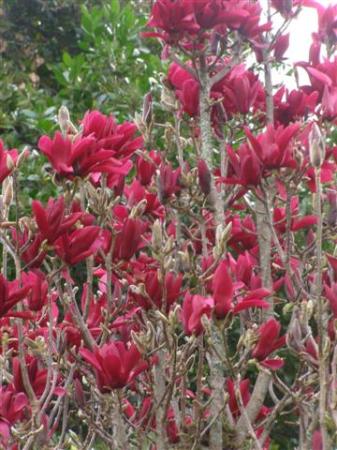
Burgundy Star is the last of our reds to open and the original plant in our carpark is nowhere near to peaking yet. It is a very dark red and on the tree appears to have lost much of the magenta tone which can dominate the other reds. Mark is still hoping that he will get a good plant which is pure red (and we have some hopeful candidates on the track) but in the meantime Burgundy Star makes a very deep red pillar. It being three quarter liliiflora nigra, we are hopeful it may have more hardiness than some of our other selections.

The Snow Flurry series flower on

The Snow Flurry series flower on

Serene is the last flagship magnolia to flower here and is just opening the first flowers. None of the American yellows are open yet, but these mostly flower too late for us and are breaking into leaf at the same time. The doltsopa hybrid Snow Flurry series of michelias flower on and are wonderfully rewarding. The season on the michelias lasts considerably longer and we have many to follow. Alas we have to be very circumspect about what we show of new breeding lest it cut across the chance to patent later so this diary will not be showing the flowerings which make us most excited here.

Magnolia Diary number 8, 29 August 2009

Click to see all Magnolia diary entries

Click on the Magnolia diary logo above to see all diary entries

Mark Jury in full flower

Mark Jury in full flower

Back in the 1950s when Felix Jury was establishing the garden here, one of the plants he coveted was Magnolia Lanarth. He ordered it from Hilliers in the UK. History is a little vague as to what number and form the plant material took (scions or plants) but it included a seedling which, when it flowered after a number of years, was clearly not the solid purple flower of the chosen cultivar. No, instead it was very large and pale lavender pink and white. Enquiries from Hilliers established that it was most likely a cross between Lanarth and sargentiana robusta. Felix did manage to establish true Lanarth (Magnolia diary entries 1 and 4 have photos of the splendid specimen after fifty years), but the chance seedling proved to be the jump start for a breeding programme. Felix subsequently named it Mark Jury, for his youngest son and it has been distributed in the trade both in New Zealand and overseas. We have never promoted it widely ourselves. Although it makes a splendid large tree for a park, we think the next generation are superior garden plants.

Athene

Athene

From Magnolia Mark Jury came Iolanthe (ref Diary 7), Milky Way, Lotus, Athene and Atlas (all involving forms of lennei) which are all flowering now. Apollo too is flowering (this one does not have Mark in its lineage, being thought instead to be a liliiflora nigra hybrid crossed with Lanarth). Picking favourites is all about taste. Iolanthe has an exceptionally long flowering season and a large flower with good colour here (though we were disappointed at how it looked in Switzerland at Eisenhuts and it does not appear to be the stand out performer in the UK and Europe that it is here). Lotus has a perfect form in pure cream but can take 5 or 6 years to settle into good flowering. Athene has blooms which in our eyes are simply beautiful. Atlas had the largest flowers imaginable until rivaled by Felix. Apollo is our best purple so far. Milky Way is just an all round top performer. What more can we say? Felix’s legacy is still remarkable.

Magnolia Apollo, Felix's best purple

Magnolia Apollo, Felix's best purple

Daphne genkwa – flowering this week

Click to see recent Flowering the week entries

Click on the logo above to see all Flowering the week entries

Daphne genkwa - a vision in lilac blue

Daphne genkwa - a vision in lilac blue

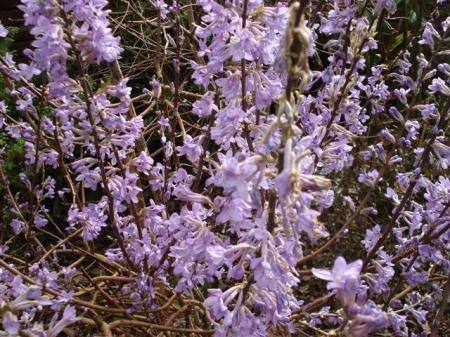
A daphne with no scent? What sort of plant is that? So asked a weekend visitor but we all agreed here that any plant that can look like this is worth its weight in gold. It is completely deciduous so flowers with no leaves at all and every arching branch is smothered in pure lilac blue flowers and has been for a good couple of weeks now. There are not many relatively compact shrubs that mass flower in late winter, let alone in blue. It makes such a statement in the garden that we are resolved to propagate more to use.

Genkwa is an oriental species, native to China and long prized in Japanese gardens. It can be a touchy character to get established. This specimen is our third effort but it is worth persevering. It is available on the New Zealand market though you may need to find an obliging garden centre to order it in for you if they do not have it in stock.