Tag Archives: Mark and Abbie Jury

About a meadow. An update.

The new meadow look in our park - long grass and mown paths

The new meadow look in our park – long grass and mown paths

Wildflower meadows sound so delightfully romantic and evocative. And they can be in practice, but there is not just one way of achieving this.

When we talk about ‘wildflowers’ in New Zealand gardening, we are not talking about our own native wildflowers. They are native to somewhere but not here. Most people think of mixes of cornflowers, simple poppies, nigella, cosmos, maybe Queen Anne’s lace and the like. What are sold as wildflowers here are generally a mix of flowering annuals, though not the highly-bred ones that are used for potted colour and bedding plants. You can call it gardening because it is generally necessary to cultivate the soil, eliminate at least some of weed regrowth which will swamp the chosen annuals, plant the seeds and water them in. Merely broadcasting them on poor ground is rarely successful. These sowings of mixed annuals are usually disappointing in the second year because the influx of weeds and grass will swamp out most of the plants that have managed to seed down and the effect is very different. So it is gardening with annual flowering plants in its simplest form with next to no hard landscaping. It is also best suited to drier climates without the strong grass growth we get here and not prone to torrential downpours which will flatten these gentle, elongated plants. Charming though areas of mixed annuals sown in this way can be, it is not for us. And I would describe it as gardening with annuals, not a wildflower meadow or a wildflower garden.
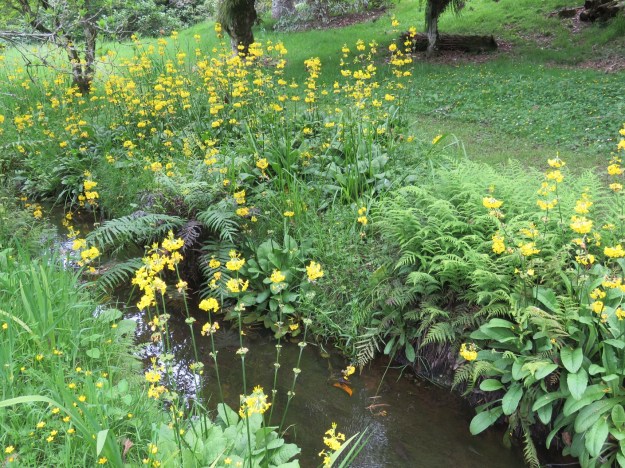
Lots of Primula helodoxa in our meadow at this time of year

Lots of Primula helodoxa in our meadow at this time of year

Our interest starts with meadows now. This presupposes a heavy presence of grass and many plants that are deemed weeds in more cultivated areas. Why meadows? Four reasons:

  • Meadows make a hugely greater contribution to natural ecosystems than mown grass. They provide food for bees, butterflies and other insects while offering cover to the smaller creatures of the natural world.
  • We are seriously discussing and experimenting with techniques of lower input gardening where possible. Mark has become increasingly concerned at our heavy reliance on the internal combustion engine to maintain our garden – the lawnmower, weed-eater, leaf blower, hedge trimmer, rotary hoe and more. We have already phased out most spraying and fertiliser use – preferring to use our own compost – so the run-off from our property will be neither toxic nor high in nitrogen. Next up was to consider ways to significantly reduce our usage of petrol powered engines.
  • We are mindful that we have a large garden managed by just three of us. Because we have no plans to retire off the property, we need to ensure that we can maintain the garden to the standard we want into the future as we age. This is another reason for finding ways that are more sustainable in the long term.
  • We like the simplicity of meadows, the romanticism and the natural feel. We wanted to see if we could manage it in our garden.
Higo iris and primula are looking pretty this week

Higo iris and primula are looking pretty this week

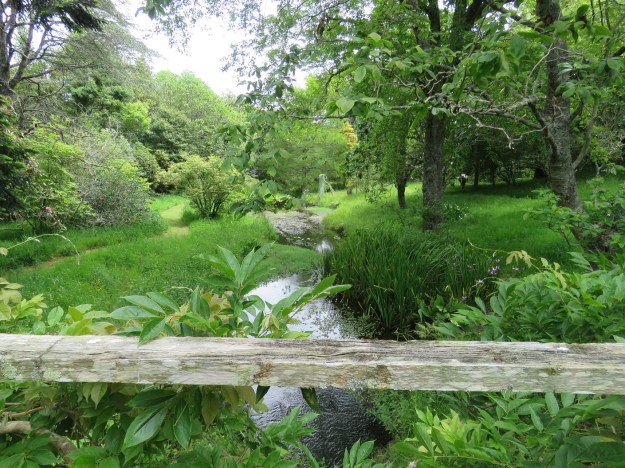
We closed the garden to the public three years ago and immediately started experimenting in the area we call the park. With its variable terrain and a stream flowing through, this area was originally planted by Mark’s father, solely in trees and shrubs, and it covers about 4 acres. A small flock of sheep kept the grass down and most weeds at bay. When we bought the Rolls Royce of lawnmowers (a Walker mower) that could cope with all the steep slopes, we banished the sheep, removed the fencing and started mowing the park on a regular basis. The areas that couldn’t be mown were kept down with the weed-eater. Finally, Mark could start some underplanting.

img_3130Now we have long grass with mown paths through it. After three years, there is increasing diversity in the plants moving in. Many are commonly seen as weeds and the whole debate about weeds needs more attention another time. Not just buttercups, daisies and dandelions, though we have those in abundance. We also have Herb Robert moving in (Geranium robertianum), clover pink and clover white, foxgloves, self-heal (Prunella vulgaris), Mark’s stinking billy-goat weed (a stachys), montbretia and more. I am not keen on the docks or thistles, so I try and dig those out. Mark is particularly pleased that we had a lot more brown top in the existing grass mix than he had thought because it has beautiful silky seedheads that wave in the lightest of breezes.

To these ‘volunteers’ (or genuine wildflowers that have made their way of their own accord), we add our own enhancements – primulas beside the stream, along with a range of other marginal plants and irises. Even sarracenia and a few orchids (the dactylorhiza orchids work though most of the disas died out). The Higo iris are coming into bloom and what a delight they are. In autumn and spring we have bulbs and we no longer have to worry about mowing off the foliage too early.

The placing of mown paths throughout has been successful, giving a contrast between the walking areas and the natural meadow, though it helps to have Mark’s good visual instinct to get the form of the paths sorted from early on so that they meander gracefully. At my request, these were widened to be two mower widths across – a single width looked a bit mean and perfunctory.

The Walker mower
The Walker mower

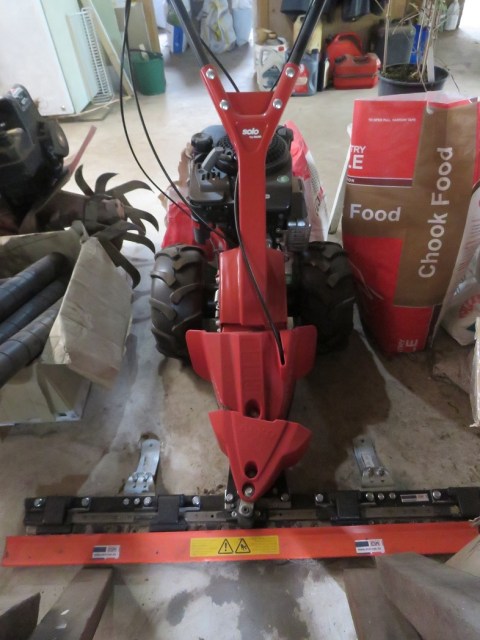
New sickle bar mower

New sickle bar mower

We mow everything once a year in autumn and I have to admit this involved the purchase of a new internal combustion engine – the sickle bar mower. The lovely ride-on Walker was never designed for the mowing of the meadow, being better on grass that is kept consistently shorter. The sickle bar emulates the motion of an old-fashioned sickle and is designed to cope with this sort of situation. We do not follow the British wisdom of removing all the hay to keep fertility low. It is not practical in our situation and our meadow is a year-round affair because of our mild climate where plants keep growing even through winter.

Going into our fourth year, we are saying ‘so far, so good’. It is not for everyone, but we love the look. If we are still continuing the park as a managed meadow in another five years, we will then be willing to announce that it has been successful for us. The mid-term report is that we have achieved a meadow and it is certainly meeting our four reasons for starting the experiment.

A treasured memory - our second daughter in a dry climate flowery meadow in the Nelson area around 1994

A treasured memory – our second daughter in a dry climate flowery field in the Nelson area around 1994

Postscript: Ken Thompson in The Sceptical Gardener writes about real meadows and I quote just a brief excerpt there: “it actually is a meadow in the sense of an area of perennial grass and wildflowers, managed by annual cutting.” He goes on to discuss what he calls the ‘annual meadow’ – drifts of annuals. “The problem is that ‘annual meadows’, whatever they are, are not meadows; they don’t look like meadows, and nor are they managed by meadows.”

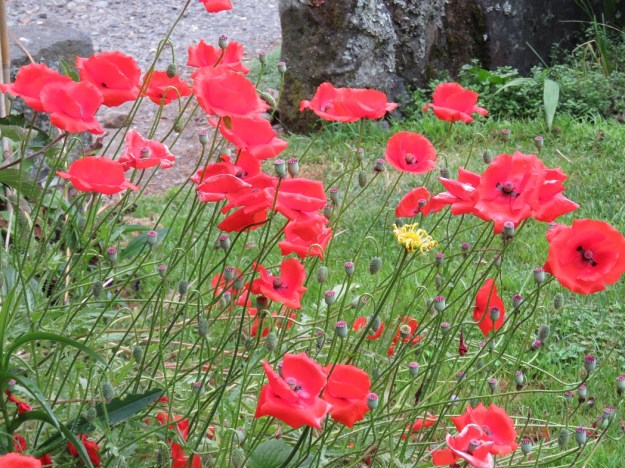
He draws on a British garden writer and TV presenter about poppies. “Nigel Colborn reports that a visitor to his garden asked why his meadow had not wild poppies in it. Nigel had to explain, kindly and tactfully I’m sure, that no meadow since the dawn of time has had poppies in it, and that poppies belong in cornfields.”

Thompson also has an interesting chapter about the common lore that wildflowers do better in areas of low fertility. This is a book to put on Christmas present lists, as I said in my review earlier.

Tikorangi Notes – of earthquakes, tree ferns and a meadow experiment

I think the Americans will like our sino nuttallii rhododendrons in bloom (and we won't mention their new president)

I think the Americans will like our sino nuttallii rhododendrons in bloom (and we won’t mention their new president)

It has been a discombobulating week. For overseas readers, I should explain it started with another major earthquake. Despite the quake being centred on the east coast of the South Island (we are the west coast of the North Island), it was the worst one Mark and I have ever felt. And I say that as inhabitants of what are sometimes called the shaky isles where we have all been raised with advice and practice at school on how to behave in an earthquake. Even here, the rocking ground was enough to significantly drop the water level in the swimming pool and to have the water sloshing out of the upstairs toilet cistern. Fortunately, after the Christchurch earthquakes, we had secured our tall pieces of furniture and bookcases.

Further south the damage has been huge and the enormity of this event is still being revealed. It is major and will take years to repair – damaged townships and settlements but also the main trunk road and rail services are completely out of commission and it is difficult to see how and when repairs will be possible. Being a sparsely populated area of this country, there is very little in the way of alternative routes available. Our hearts go out to the people so badly affected.

Closer to home, we have been sprucing up for a small American tour due on Wednesday. This is the first tour we have accepted since we closed the garden three years ago and there is nothing like knowing you will be hosting an overseas group to focus one’s eyes differently. We will not be raising the topic of their recent presidential elections (I think there may be a huge gap – a chasm, even – between how much of the world views that event and how it is seen internally by too many in the USA, so best avoided).

New shoot on black mamaku

New shoot on black mamaku

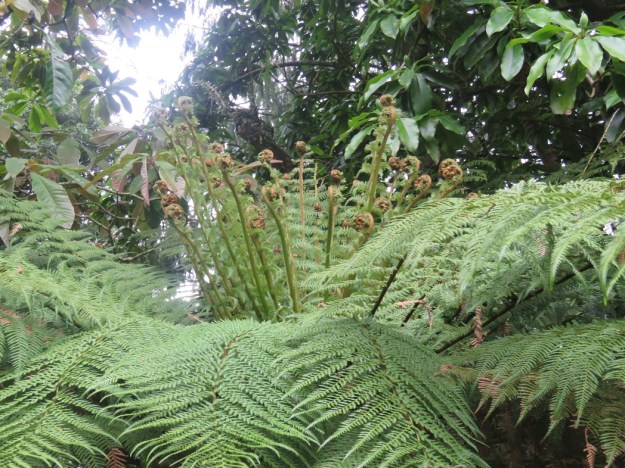
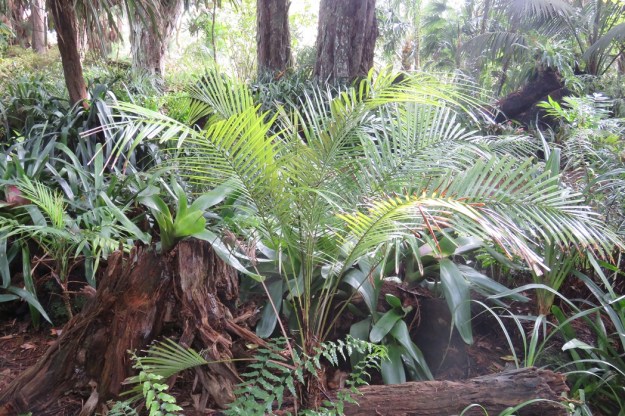
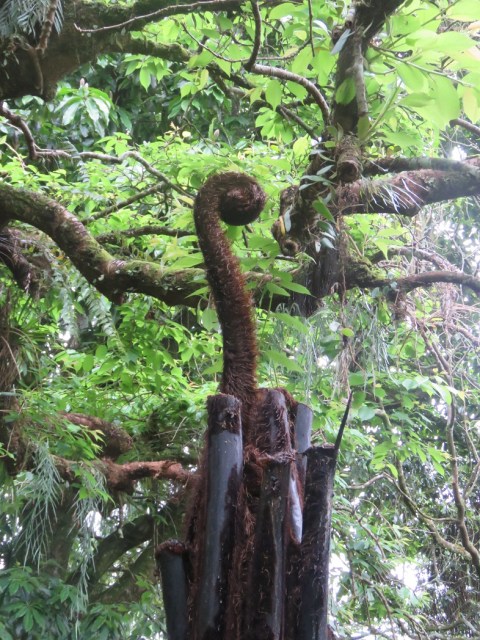
I expect they will notice our tree ferns. Here they just seed down and we cut them out (eventually) if they are in the wrong place. I cut all the fronds off the wheki (Dicksonia squarrosa) and the black mamaku (Cyathea medullaris) in preparation for the chainsaw. I have no intention of ever learning to use the chainsaw myself. It terrifies me. It is one job I leave for the men in my life. The new shoots on the denuded trunks are wonderfully decorative – icons, even, of New Zealand design. We also have plenty silver ferns (Cyathea dealbata) popping up around the place.

I think it is a wheki (Dicksonia squarrosa)

I think it is a wheki (Dicksonia squarrosa)

While tree ferns, or pongas as we call them here (pronounced ‘punga’) are closely associated with New Zealand, the most common form grown with care – bordering on reverence, almost – in Europe and the UK is actually an Australian native, Dicksonia antarctica. Visitors from the northern hemisphere are usually in awe of them occurring naturally here and being seen as expendable when they pop up in the wrong place.

Tomorrow morning on Radio Live’s Home and Garden Show, Tony Murrell and I will be discussing meadow gardens. **** Given that these discussions take place between 6.30 and 7.00 in the morning, it is always something of a surprise to me when people comment that they listen. But it is quite liberating to be chatting that early because it gives a certain freedom in these extended conversations which both Tony and I enjoy a great deal. If you are interested in listening later, the link gets posted on both Radio Live’s Facebook page and, I think, their website. Last week we were talking about Piet Oudolf and the new perennials style.

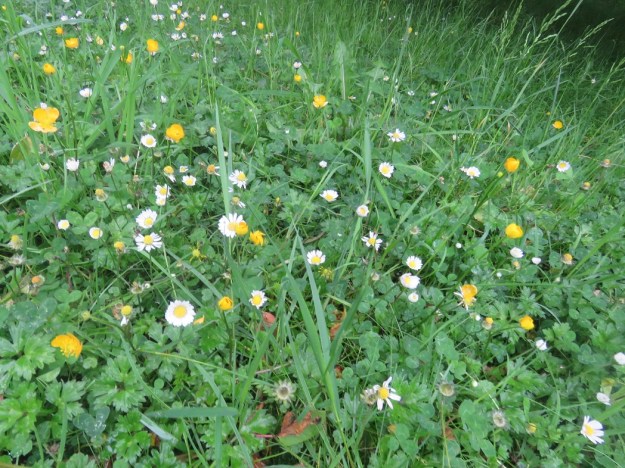
Buttercups and daisies - weeds or a meadow?

Buttercups and daisies – weeds or a meadow?

We are into our fourth spring season of experimenting with letting much of the park develop into a meadow. At this stage, our meadow is a mix of naturally occurring plants with the addition of bulbs, irises and primulas, managed with minimal intervention.  It is a challenging process in terms of how we view weeds. Certainly it is looking very pretty at the moment with carpets of buttercups and daisies and even the dandelions look colourful. I am okay with some pink Herb Robert getting away, also monarda (bergamot or bee balm) but I draw the line at docks. Mark’s particular hate is the plant he refers to as ‘stinking billy goat weed’ but the internet does not appear to agree with him on the name. Also, it is not to be confused with horny goat weed or blue billygoat weed. He is right that it is a stachys and a stinky stachys at that. It is the smell that he hates so we are generally pulling it out. I did a search and the photos seem to correlate with Stachys macrantha. If that is correct, it is a great deal more appreciated overseas than in our park. Maybe a reader can enlighten me whether S. macrantha has a pungent odour when disturbed?

A wheki which still has its old foliage undisturbed

A wheki which still has its old foliage undisturbed

*** Update: No discussion on meadows this morning on Radio Live, due to circumstances beyond everybody’s control. Instead I discussed outdoor furniture with Hamish Dodd. Meadows with Tony Murrell next Sunday at 6.35am.

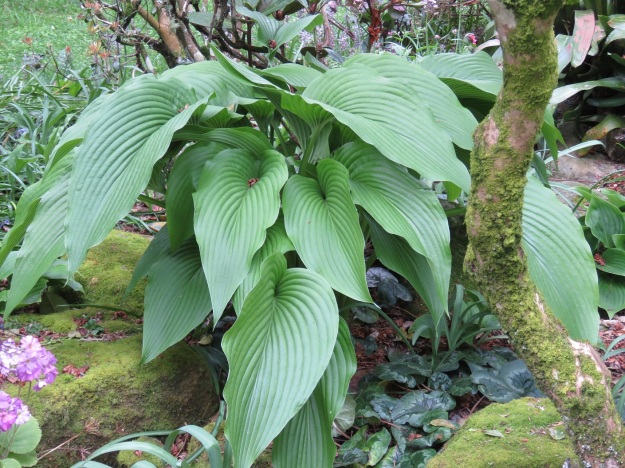
Hosta Time


Hostas planted with Ranunculus cortusifolius, Chatham Island forget-me-not and meconopsis

Hostas planted with Ranunculus cortusifolius, Chatham Island forget-me-not and meconopsis

November sees hostas looking their very best. We used to grow hostas when we were still running the nursery. From memory, it was in the vicinity of four or five thousand every year, year in and year out, across maybe 35 different varieties. There is not much we don’t know about propagating and growing this plant family in containers. We always sold plants raised by division – not from tissue culture – and earned a reputation for a large and luscious grade.

Growing plants in a garden is different and now that we are gardening full time, we have taken a great deal more interest in their long term performance. Not all hostas are equal. Nor are they quite the low maintenance plant that is often claimed. Once the ground around them starts to compact, it is not uncommon to suddenly realise that a well-established clump has reached the point where it is getting smaller not larger. Smaller clumps which are not thriving may disappear altogether, even though they are in the recommended humus-rich shade. They like cultivated soil and will do better if given better conditions, especially the touchier varieties.

One of Mark's reliable blue seedling hostas

One of Mark’s reliable blue seedling hostas

The one exception has been a run of big blue hostas that Mark raised from seed. These are still handsome, large and fine after maybe two decades with absolutely no attention at all. The same cannot be said of all varieties. Alas, a number of the fancy newer ones are better in pots than the garden.

There is no doubt that hostas are a highly desirable dish on the smorgasbord of slug and snail food. I have seen plants eaten away to almost nothing, particularly in UK gardens where they seem to have a much worse problem than here, though I have been told Auckland snails may rival them. Should I therefore whisper that we don’t seem to have a big problem here? We so rarely use snail bait that neither of us can ever remember where the packet may be. Instead, we have reached an accord with the birds and they carry out constant pest patrols to keep the critters at bay. But if you are resorting to baits, remember that they are a poison, not a fertiliser. You only need two or three pellets per plant and more is not better. If you are not a slug bait fan, I did try the technique of baker’s bran and found that worked. Circle the plant generously with bran. I don’t think it actually kills the slugs and snails but they find it so irresistible they can’t stop eating it. Once in the gut, it swells and they lie around in a bloated fashion til the morning when the birds find them. Think of it as adding protein and fibre to the ornithological diet rather than subjecting them to toxins.

Softer leaves are more vulnerable to critter damage, so if you have an issue, go for the varieties with tough, almost leathery leaves.

Hosta Jade Cascade

Hosta Jade Cascade

When it comes to locating them in the garden, it will be no surprise that we go for mix and match. Hostas love similar conditions to clivias, ferns, some of the primulas, meconopsis, Chatham Island forget-me-not and other plants which we use in damper, cooler situations of semi shade. They are not so keen on deep shade and will turn all green if they don’t get sufficient light. Gardeners in colder climates have more leeway in terms of sunnier positions but the yellows and pale variegations burn in the summer sun here.

OLYMPUS DIGITAL CAMERAMany gardeners seem to prefer to group their hostas together in a hosta bed. It is not compulsory to plant them this way but if you prefer this look, I will repeat my advice given often to customers back in the days. Don’t be wooed into buying only the showy, variegated ones and bunging them all in together. It is the plainer hostas in single colours, and the variety in leaf form, shape and size that set off the fancy ones and avoid a mishmash. One fancy one to at least three plainer ones is my rule of thumb. These days, our preference lies with the solid coloured ones rather than variegated varieties.

Hands-on gardeners know that big clumps of hostas can be dug and divided in the same way as any other perennial plant. In terms of timing, it is best to do this in winter or early spring in our climate.

Running a mailorder business taught me never to take anything for granted. Hostas are deciduous, a fact that eluded one customer. “I am not happy with my order,” she wrote. “It looks as if there has been a rabbit in the box, eating the foliage. Or if they are deciduous, I don’t want them.”

It is the fresh foliage in spring that is the highlight for this plant family and some varieties will follow up with a showy floral display in shades of white, blue or, most commonly, lilac-purple shades in summer.

Hosta Regal Splendour (front) and Fragrant Blue

Hosta Regal Splendour (front) and Fragrant Blue

First published in the November issue of New Zealand Gardener and reprinted here with their permission. 

Feathered friends

Would you mess with this cat? Few people ever tried a second time.

Would you mess with this cat? Few people ever tried a second time.

The decision not to replace our last cat – when she shuffled off the mortal coils after 16 long years of cantankerous and unpredictable behaviour – was not taken lightly. Both Mark and I had lived with cats all our lives and were fond of the furry, purry things. But they are killers and we prefer the birds. That decision has certainly had a huge impact on our bird population here. It helps that none of our neighbours have cats and that there has been some control exercised over feral felines. This spring, we are particularly aware of the huge number and variety of birds in residence and feeling that we may have achieved something of a sustainable ecosystem which maintains an all year-round population. Mark’s ongoing efforts to reduce rat numbers by trapping may also have helped.

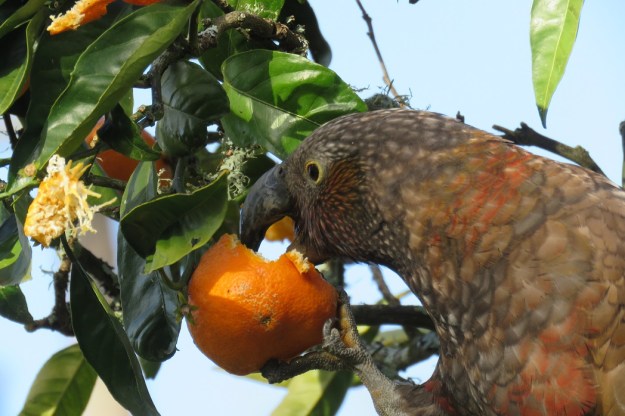
Our kaka!

Our kaka!

Not even the late Buffy cat could have had an impact on the most exciting arrival this year. It was a kaka – one of our native parrots which is limited to small, defined areas of the country these days, nowhere near here. We had never seen one before. A loud, noisy larrikin it was too, one which enjoyed rarking up the tui, swooping around the place feeding from a variety of sources including the mandarin trees. We were not so impressed at it pulling off fat magnolia buds just to throw around for no clear reason (we did wonder if it was aiming at the tui). After about two months it moved on, perhaps looking for a mate and it has seemed a little quiet here since.

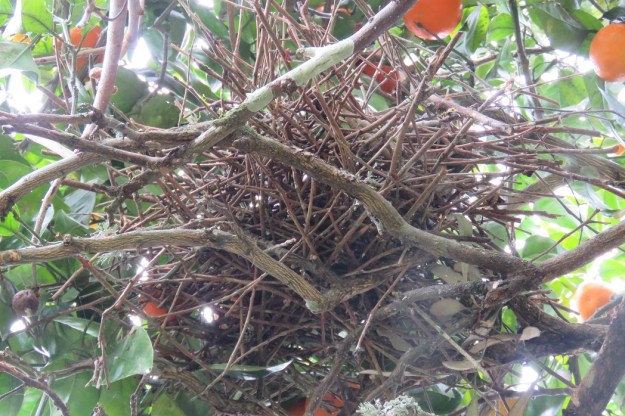
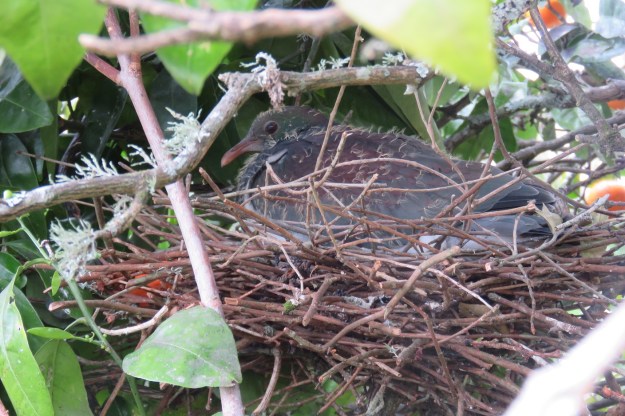
The kereru nest scores about 1/10 for skill are care.

The kereru nest scores about 1/10 for skill and care. Viewed from below. 

Baby kereru in residence

Baby kereru in residence

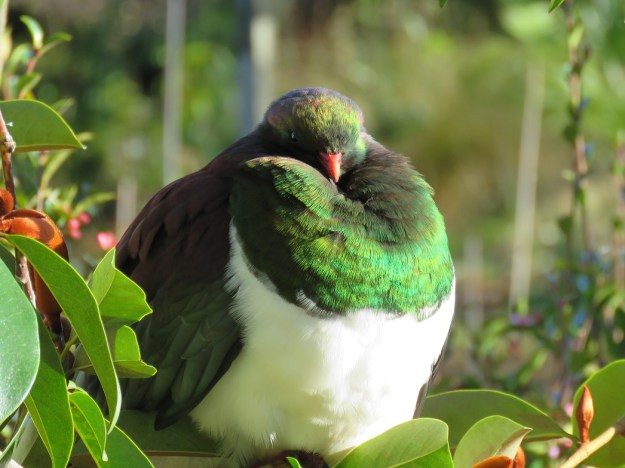
The kereru – our great, lumbering native wood pigeon of small brain –  are a constant garden presence. They also sit about look decorative, posing almost, as they eat the magnolia and michelia flowers and anything else that takes their fancy. Fortunately we have plenty to share. But I thought that few readers are likely to have seen their nests. These are not creations of great skill and care – more a case of throwing a few twigs together and hoping it lasts long enough for the single baby to mature to flying stage. Sometimes the nests do not last the distance, alas. Mark manoeuvred the ladder into position with some difficulty so I could photograph the rather large baby in residence. I will keep an eye on it to see if I can catch the parents coming in to feed it.

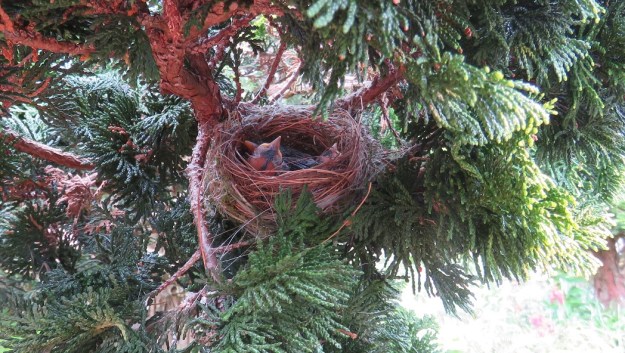
Wax-eyes craft exquisite tiny nests

Wax-eyes craft exquisite tiny nests

What the kereru lack in nest-building skills, the wax-eyes more than make up with their exquisite little creations mere centimetres across. I found this one two days ago in a conifer I was cleaning out (removing the clutter of dead needles improves the look and air circulation enormously). The hatchlings were so tiny that at first I thought they were berries that had fallen into an old nest and my eyes had difficulty focusing on the minute movements that showed they were living. I backed off immediately. Finishing the grooming of the conifer will have to wait. Two days later, today, I checked again and the babies are now looking up with their mouths open, waiting to be fed.

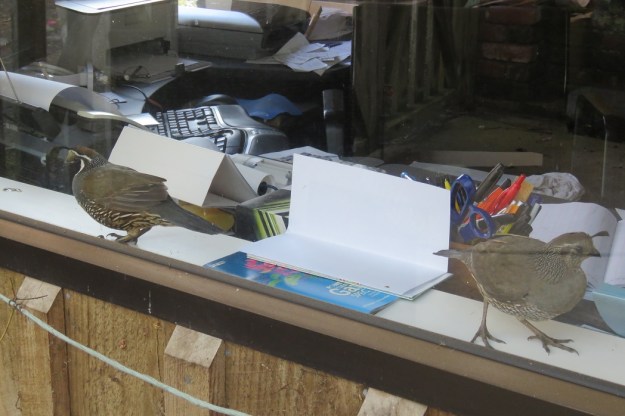
Trapped on the inside - Californian quail

Trapped on the inside – Californian quail

We would not have the mob of quail that have built up, had we kept a cat. They spend most of their time on the ground and they usually nest at ground level, then lead their babies around from the earliest stage when they still look like little feathered bumblebees, long before they are big enough to fly. I could, however, have done without the two who wandered into my office one night when the door had been left open by mistake and who then could not work out how to exit.

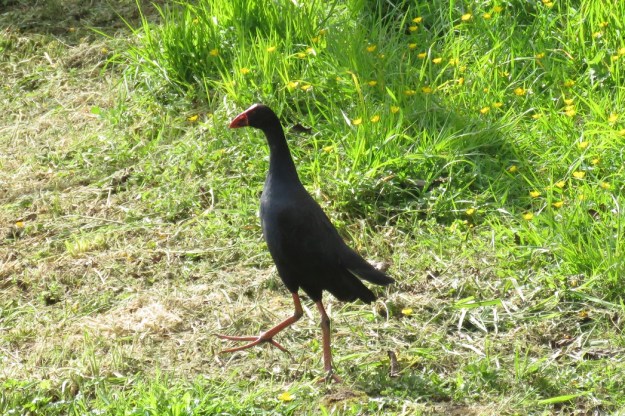
Agitated young pukeko

Agitated young pukeko

I haven’t even mentioned the pair of white-faced herons currently nesting in the Pinus muricata yet but neither have I been around with my camera at the right time to photograph them entering or leaving the nest which is maybe 30 metres up.  We are hoping that the cretinous man who shot two white-faced herons in the area because they were stealing his goldfish (!!!!) is now too old to still be wielding a gun. I can, however, give you the young pukeko separated from its parents down in the North Garden – and very agitated they all were by my presence there with the dog. These native swamp hens that rarely fly far are wonderful exemplars of survival and adaptability and therefore so common that they are taken for granted and never given the status of their highly endangered cousins, the takahe.

One of the bonuses of having a garden filled with birdlife is that we do not have much of a problem with slugs and snails. As far as we are concerned, good gardening is about establishing good eco-systems as much as it is about pretty flowers.

We once had a much-loved ginger cat called Moomintroll (or ‘The Troll’ for short). He lived to a ripe old aged despite two broken legs in kittenhood, the second requiring amputation. From this misfortune, I learned that three legged cats are good rodent catchers but can’t get the elevation to catch birds. I did wonder about putting a standing order with the local SPCA for a three-legged cat but there is a problem. All our cats have always been ginger, male or female. As far as I am concerned, all cats should therefore be ginger and a standing order for a three-legged ginger moggy who is confident living with dogs might be altogether too specific. We will stick with the birds.

The handsome kereru, our native wood pigeon

The handsome kereru, our native wood pigeon

Tikorangi Notes: Sunday October 9, 2016

 I vowed I would complete The Mission of the 78 Azaleas in July.  I am almost there, which is to say I am down to the last two plants needing a home. The trouble with being down to the last two, is that they suddenly take on psychological significance. There are no more sitting in the nursery to draw on so I must make sure that these last two are in The Right Place. I don’t want to suddenly find a spot which I missed that is calling out for a bright spot of colour. It may take a little longer.

img_2427In the meantime, it is The Challenge of the Lytocaryum weddellianum. This is a very pretty little, feathery palm from Brazil, a close relative of the coconut palm but small. It is sometimes referred to as the wedding palm (presumably because it is favoured in pots as green decoration at wedding receptions?). There are a reasonable number of them sitting out in the nursery that Mark bought as baby plants years ago. It is doing particularly well in the subtropical gardens beneath the rimu trees.
Lytocaryum weddellianum is a bit of an in-house (or in-garden) gag here. Others often give the advice to repeat a plant in a garden to give unity. I have always doubted this because too often it is done with common plants like renga renga lilies (arthropodium) or the tractor seat ligularia (L. reniformis).  I once saw it done with Dahlia ‘Bonne Esperance’ and I came to the conclusion that all that repetition does is to ensure that your garden all looks the same. Nevertheless, I am threading the lytocaryum through one area on the grounds that if you are going to repeat a plant to gain unity, you might as well do it with class and botanical depth.

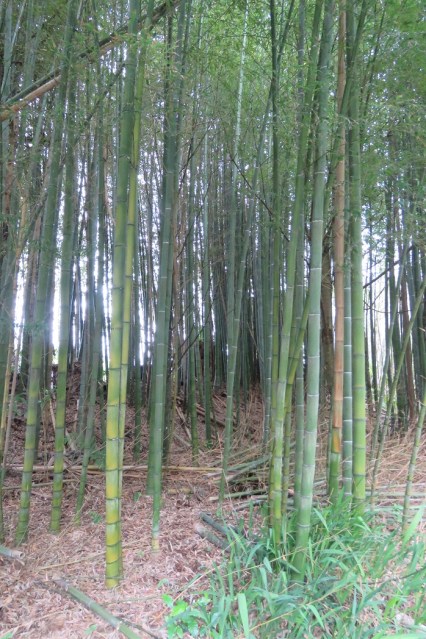
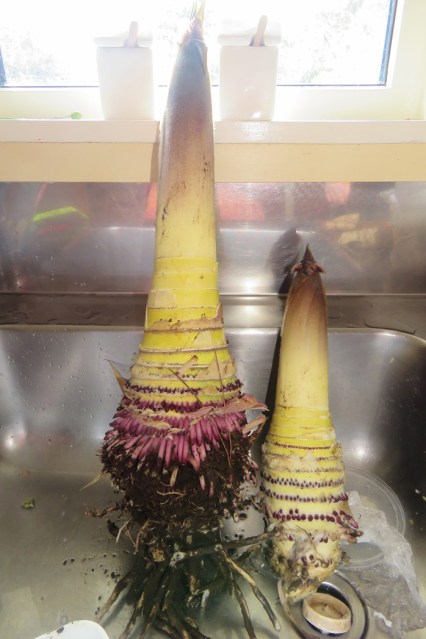
img_2406We have a relatively large forest of a giant bamboo – in this case Phyllostachys edulis. The neighbour wishes it was not on the boundary and we are trying to be vigilant this spring and doing a weekly round of jumping the fence to grub out the new shoots that insist on popping up in the farm next door. It is a handsome bamboo and of some use as cut lengths in the garden. It is also edible. Sadly, panda bears have not arrived to take advantage of the food source (further proof that the cargo cult does not work) but I am having another go at cooking the fresh shoots this year. To be honest, the bamboo shoots that you buy in tins taste more of the brine than anything else. And even fresh, they are more textural and a carrier of other flavours (as tofu is) than a taste treat in their own right. But they add variety to our diet and I can see a use for them in stirfries. “Please bring me some bamboo shoots for dinner,” I asked the other night. And he did. The big one is past cooking stage. The trick seems to be to harvest them just as they come through the ground and to prepare the white sections that are below the surface.  I shall slice some, blanch them quickly in boiling water and then freeze them to see if we use them later in the year. The first batch I poached gently in stock before adding to the dinner that night and they were pleasant, if not life-changing.
img_2420The deciduous magnolia season is over, bar Magnolia Serene which is always the last to bloom and is still a picture. So I can now admit that 2016 was not a memorable year. The rain, rain and yet more incessant rain combined with mild temperatures turned many to slush – botrytis, Mark says, on a scale we have not seen before. I really struggled to get good photos. There is always next year when the weather gods may be kinder.

img_2392Now it is bluebell time. It appears that ours are all Spanish bluebells or hybrids. The pink and white variants are a bit of a giveaway. Ken Thompson in The Sceptical Gardener gave me a handy guide to tell the difference between the blue ones – which are English, Spanish or hybrids. I stopped by the site of one of the original houses in Tikorangi where bluebells continue to flower. Mark thought that they are probably the oldest bluebells in Tikorangi so may date back to the early settlers and therefore more likely to be the English bluebell. Nope. Indubitably of Spanish origin too.

But Spanish or English or a mix of the two, a carpet of bluebells is a pretty sight and leads in to a poem written by a friend who stayed with us last week.

img_2377Bluebell Woods

Red Riding Hood haunts the Bluebell Woods

plucking her squelchy bouquet.

Nasturtiums Humpty down the bank

trumpeting and capering on their way.

Celandine tells of golden cups

quaffed by golden kings


But the scarlet poppies alone in the field

have only songs of war to sing.

J F Panting

img_6683