 I read a report last week about leading Auckland mayoral candidate, Phil Goff’s plan to plant a million trees around Auckland. Good luck on that one, Phil, I thought. For many New Zealanders do not like trees.
I was telling Mark about findings in The Sceptical Gardener, by Ken Thompson, who is clearly interested in the effect of a garden and trees on real estate prices. First he quoted a US study. From Lubbock, in Texas, no less. The shorter version is that if you have a garden that is a rich, layered eco-system that supports a wide range of different birds, the correlation is that it adds US$32,028 to the value of your real estate when you go to sell it. There is more – another chapter on determining the value of trees, both planted on your own section and also on the road verge. A Perth (Western Australia) study shows broad-leafed trees on the road verge add AU$16,889 to the value of your adjacent real estate. That is a very precise sum.
“Not in New Zealand,” was Mark’s comment, articulating what I had already thought. “It is more likely to devalue your property by that amount in New Zealand.” For many New Zealanders do not like trees.
 Why, when we live in a country that was until very recently, heavily forested, do so many people hate trees here? Why do so many folk want to hack back or cut out anything over two metres in height? And why do we so often see the death sentence pronounced and carried out on trees once they have reached about fifty years of age? “Past their use-by date”, it is often claimed even though the tree may in fact have a life expectancy of hundreds of years.
I used to think that maybe it was a visceral response that harks back to the difficult conditions encountered by our early settler forbears who arrived expecting to find pleasant green, rolling lands but instead had to start by hacking out dense, impenetrable forest in order to find a place to stand.
Upon reflection, it is more likely a response to conditions whereby our climate is not quite as warm as most of us would like and our housing stock is generally of low quality – at least when compared to other western societies and cooler climates. Often poorly insulated, if at all, and inadequately heated, most of us rely on passive solar heating so we want sun, sun and more sun. Woe betide any tree that might block a ray of sun or indeed any view. We are still a very new country with little respect, let alone reverence, for the past.
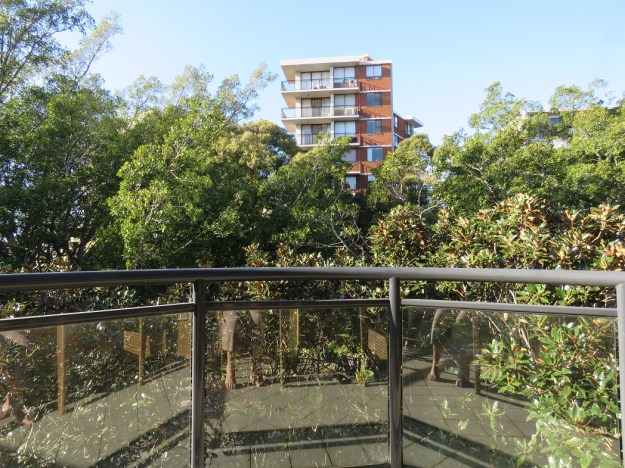
Third floor balcony of a Sydney apartment
I am just back from a visit to Australia where both our two daughters live and I could not help but notice the greater role played by trees in that country. Sydney daughter has a third floor apartment with a good-sized balcony and how bleak that setting would be without the surrounding foliage. It is high density living not far from Bondi, with heavy traffic and residential high rise all around. Yet despite that, there are only three apartments that overlook her living area, both indoors and outdoors and the trees cushion the heavily urbanised environment. The trees are a combination of large specimens on the verge and trees planted in the garden of the ground floor apartment.

Canberra suburbia
Canberra daughter lives in a much harsher climate (hot in summer and very cold in winter) but is in one of the desirable leafy suburbs with large street trees. Canberra is a planned city and in her area, the trees are allowed to grow to maturity even at the expense of footpaths. There aren’t many footpaths at all and those that do exist, appear to be laid in slabs which would accommodate tree roots better than the unimpeded level surface poured in one that we demand in NZ suburbs. Additionally, front fences are banned – only hedges allowed – which avoids the prison look of some of Auckland’s leafy suburbs. Daughter tells me that public policy is such that where tree replacement is required, no more than 20% of trees be felled at any one time.
So good luck to Phil Goff and his million trees. Increasing housing density in Auckland means that leafy public plantings are going to be even more important to soften the urban environment. But he will be fighting some hostile attitudes from many residents.
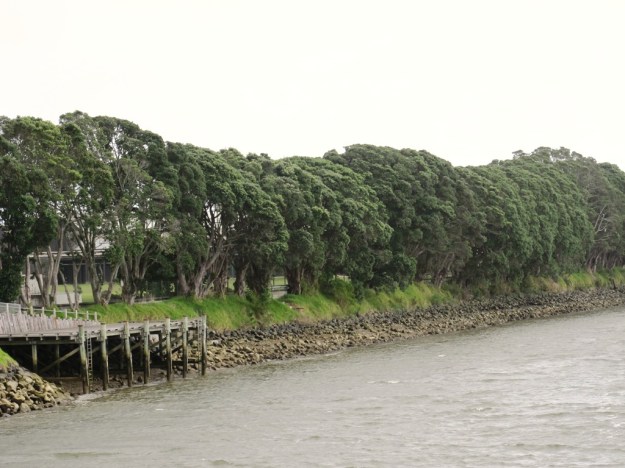 Some readers may recall our lost campaign to try and save about 29 mature pohutukawa that lined the river in our local town of Waitara.
 Believe it or not, some folk actually think this barren wasteland (now grassed) is an improvement. Three small specimens have been planted to replace the missing twenty-nine. Eventually, that is. As long as tree-hating local residents and the powers-that-be don’t hack them out before they ever reach maturity. For this is New Zealand and urban trees are not greatly valued by many.


 Not an earthquake. A falling dead tree. Pinus radiata often drops all its side branches when it dies, before keeling over or, in this case, snapping a third of the way up. This is good because the side branches can cause even more damage when a tree falls although it can and does clip other trees as it falls. As falling trees of at least 135 years of age go, this was on the minor end. The trunk broke in three as it fell, with the longest length (about nine metres) rolling over to a final location which is not bad at all, though it did initially land on a garden bed.
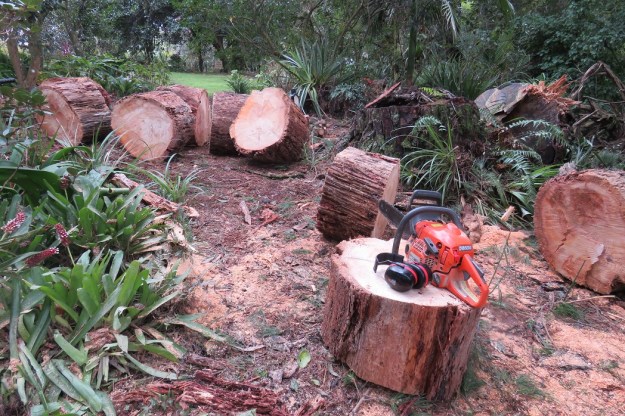 On Monday, we started clearing the paths. Surprisingly, there is quite a bit of good firewood in the centre of the trunk and by the end of the day, the pile of split wood in the shed was growing satisfactorily. There is nothing quite like the Squirrel Nutkin feel of seeing the firewood for 2017 already stacked and drying.
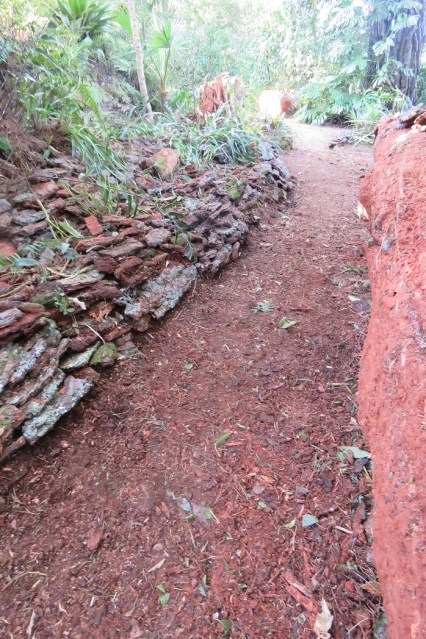 The longer lengths will remain in situ and we will garden around them. It is just a stumpery that chose to arrive. The main damage was to woodland orchids – dendrobiums and cymbidiums and some crushed bromeliads. I rescued most of the bits and replanted. There is no shortage of chunky wood chip to house all the orchid pieces. The pine bark we use as a natural edging, stacked as a low wall in places. It doesn’t break down so is relatively permanent while creating its own eco-system. I planted the odd small fern and orchid piece on the length of log to hurry up the colonisation process.
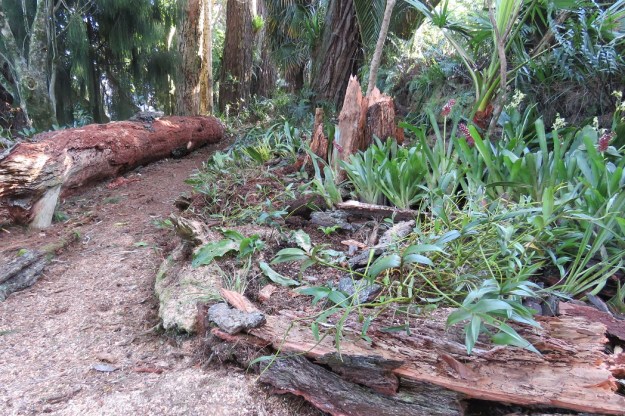 It is a lot easier to garden with nature, rather than in constant battle to keep it under control. By Tuesday, it looked like this. We are fine with that. It will settle down again over the next month or two and look as if it has always been like that.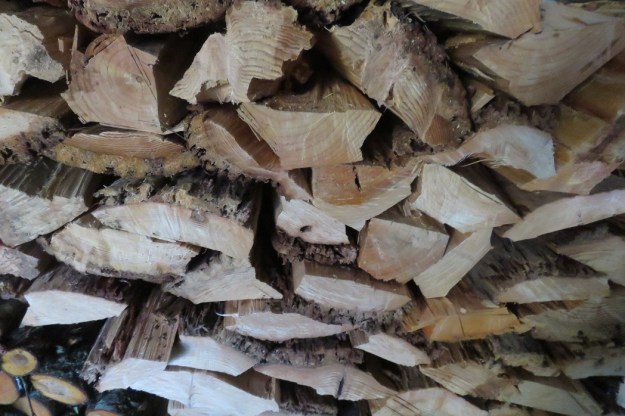
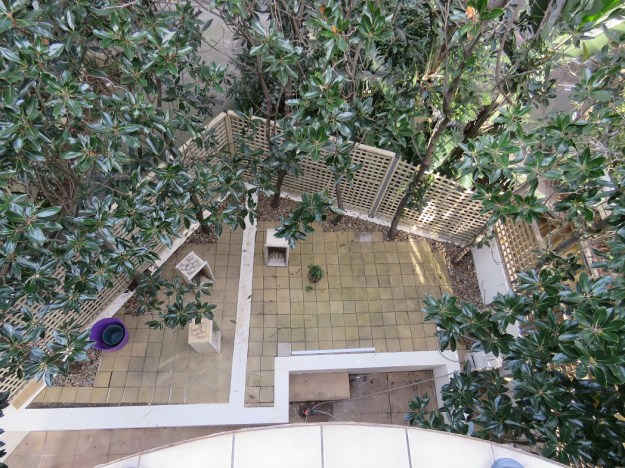 Magnolia grandiflora ‘Little Gem’.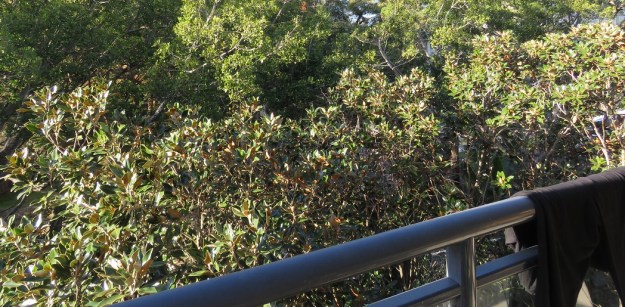
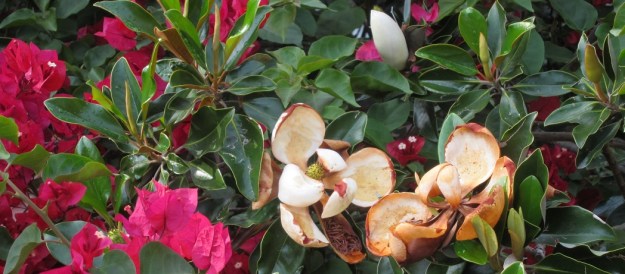 Just be warned if you are planting this handsome but ubiquitous tree in a small space. Also, do not expect a glorious floral display from the evergreen grandiflora magnolias, such as you get from deciduous magnolias and members of the evergreen michelia family. The grandiflora flowers are individually showy but short-lived and generally few in number at any time. The




 Tikorangi The Jury Garden